TL;DR
- Immersive virtual reality technology creates fully digital 3D environments where users can see, move, and interact using VR headsets, motion tracking, and real-time rendering systems.
- VR technology for business is rapidly growing as companies use it for training, design, simulation, marketing, and customer engagement across multiple industries.
- Understanding how virtual reality works helps explain how hardware and software combine to create realistic and interactive virtual experiences.
- Virtual reality immersive experience improves learning, safety, and productivity by allowing users to practice real-world tasks in controlled digital environments.
Introduction
Immersive virtual reality technology is a powerful innovation that allows people to enter fully digital worlds. Using VR headsets and sensors, users can move, look around, and interact with objects as if they are inside a real environment. This makes digital experiences more engaging and realistic than traditional screens.
Today, many industries are using VR technology for business to improve training, design, and communication. From education to healthcare and manufacturing, VR is changing how people learn and work. In this article, we will explore how VR works, where it is used, and why it is important for modern businesses.
What Is Immersive Virtual Reality Technology?
Immersive virtual reality technology is a digital system that creates a computer-generated environment where users feel like they are actually inside that world.
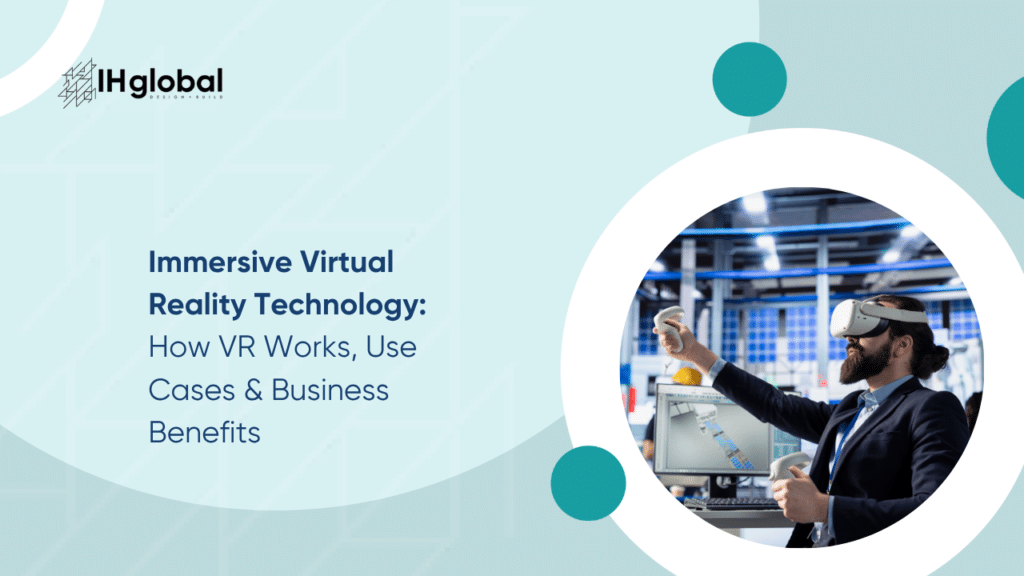
It uses VR headsets, motion sensors, and 3D graphics to replace the real world with a virtual one. Users can look around and interact with objects naturally in real time.
This technology works by tricking the human brain into believing the virtual environment is real. It responds to movements instantly, making the experience feel smooth and lifelike. Because of this, VR is widely used for learning, gaming, training, and business simulations.
For example, imagine wearing a VR headset and entering a virtual classroom. You can sit, look around, raise your hand, and interact with the teacher, just like in a real classroom, but everything is happening in a digital world.
How Virtual Reality Technology Works
Virtual reality works by combining hardware and software to create a fully digital experience that feels real to the user. It uses VR headsets, motion sensors, and powerful computers to generate 3D environments.
When a user moves their head or body, the system instantly updates the virtual world to match those movements.
The process behind how does virtual reality work can be understood in simple steps:
- VR Headset Display
The VR headset shows two slightly different images to each eye. This creates depth perception and makes the virtual environment look three-dimensional and realistic, helping users feel more present inside the digital world during the experience. - Motion Tracking Sensors
Motion tracking sensors detect head, hand, and body movements in real time. When the user moves, the system instantly updates the virtual environment, making the experience feel natural, responsive, and closely connected to real physical actions. - 3D Graphics Rendering
A powerful processor or computer generates and updates detailed 3D environments in real time. Advanced graphics engines ensure smooth visuals, realistic textures, and fast rendering so users experience a seamless and highly immersive virtual world. - Audio and Sensory Feedback
Spatial audio systems create realistic sound direction inside the virtual environment. Users hear sounds coming from specific directions, which increases immersion and makes the virtual experience feel more natural and closely connected to real-life surroundings. - Real-Time Interaction
Users can interact with virtual objects by grabbing, moving, or manipulating them. The system responds instantly to every action, creating a smooth and engaging experience that makes the digital environment feel interactive and lifelike.
In simple terms, VR works like a smart digital system that listens to your movements, shows you a 3D world, and reacts instantly so you feel like you are actually inside that virtual space.
The WHO predicts depression will be the leading global disease burden by 2030, highlighting VR’s crucial role in clinical treatment
Types of VR Systems
VR systems come in different levels based on how deeply they immerse the user into a virtual environment. Each type offers a different experience depending on hardware, software, and use case.
- Non-Immersive VR
Non-immersive VR provides a basic virtual experience using a screen like a computer or mobile device. Users interact with a digital environment but do not feel fully inside it. It is often used in simple simulations, educational tools, and basic training applications. - Semi-Immersive VR
Semi-immersive VR offers a partial sense of presence using large screens, projection systems, or simulators. It is commonly used in flight simulators, driving training, and professional skill development where users get a more realistic but still controlled experience. - Fully Immersive VR
Fully immersive VR creates a complete digital world using VR headsets, motion tracking, and sensors. Users feel fully inside the environment and can interact naturally. This is widely used in gaming, VR training simulations, healthcare, and enterprise applications.
What Makes VR Truly Immersive?
VR feels truly immersive because it combines realistic visuals, sound, and motion tracking to create a strong sense of presence. When users move their head or body, the virtual environment responds instantly, making the experience feel natural and real rather than artificial or screen-based.
Another key factor is interaction. Users can explore, touch, and control objects inside the virtual world. High-quality graphics and low delay improve realism, helping the brain accept the digital environment as real. This combination makes immersive virtual reality technology feel powerful and engaging.
The global healthcare VR market topped $4 billion in 2024, driving risk-free medical training and patient therapy through immersive simulations
10 Real-World Applications of Immersive VR Technology
Immersive virtual reality technology is used in many real-world industries to solve practical problems and improve performance. It helps people learn better, train safely, and experience situations that are difficult or expensive in real life. Below are the most common applications of VR in different fields.
- Healthcare Training and Surgery Practice
Doctors and medical students use VR to practice surgeries in a safe virtual environment. It helps them learn complex procedures without risking real patients. - Education and Virtual Classrooms
Students can explore historical places, science labs, and 3D lessons through VR. It makes learning more interactive and easy to understand. - Employee Training Simulations
Companies use VR training simulations to train employees for real-world tasks like machinery handling, safety drills, and workplace scenarios. - Manufacturing and Product Design
Engineers use VR to design and test products in a virtual space before building real models, saving time and cost. - Real Estate Virtual Tours
Buyers can explore houses and buildings through VR without physically visiting them, making property selection faster and easier. - Automotive Industry Design and Testing
Car companies use VR to design vehicles and test features before production, improving safety and efficiency. - Aviation Pilot Training
Pilots practice flying in VR simulators that replicate real flight conditions, weather, and emergencies safely. - Retail Virtual Shopping Experience
Customers can try clothes, furniture, and products virtually before buying, improving online shopping confidence. - Entertainment and Gaming Industry
VR is widely used in gaming and entertainment to create fully immersive experiences where users feel inside the game world. - Military and Defense Training
Soldiers use VR to practice missions, combat situations, and strategic planning in a safe and controlled environment.
These applications show how immersive virtual reality technology is becoming a powerful tool across industries, improving safety, learning, design, and customer experiences in a more realistic and interactive way.
Business Benefits of Immersive VR Technology
Immersive virtual reality technology is helping businesses improve how they train employees, design products, and engage customers. It creates real-like digital environments where companies can test ideas safely and reduce risks. This makes business operations faster, smarter, and more efficient in many industries.
- Better Employee Training and Learning
VR allows employees to learn through real-like simulations instead of reading manuals. This improves understanding and helps workers practice skills safely without real-world mistakes. - Lower Training and Operational Costs
Companies can reduce costs by using VR instead of physical training setups, travel, or expensive equipment. Everything can be practiced in a virtual space. - Improved Customer Engagement
Businesses can create interactive product experiences where customers explore items in 3D. This makes marketing more engaging and memorable. - Faster Product Design and Testing
Design teams can test and improve products in VR before building physical versions, saving time and reducing development errors. - Safe Simulation of Real-World Scenarios
Industries like healthcare, aviation, and manufacturing can simulate risky situations safely, helping employees prepare for real challenges.
These benefits show how immersive virtual reality technology is not just for entertainment but also a powerful business tool that improves efficiency, reduces costs, and enhances decision-making across industries.
VR in Trade Shows, Events, and Brand Experiences
Immersive virtual reality technology is changing how businesses present themselves in public spaces. It helps companies create interactive digital experiences that attract attention, improve engagement, and make information easier to understand.
Instead of traditional displays, brands now use VR to connect with audiences in a more modern and memorable way.
At trade shows, VR allows companies to build virtual booths where visitors can explore products in 3D, interact with demos, and understand complex solutions in a simple visual format. This helps brands stand out in crowded exhibition spaces and increases visitor interest and engagement.
At events, VR makes participation more flexible and global. Companies can host product launches, conferences, or training sessions in virtual environments where people join from anywhere. It removes location barriers and creates a more interactive and immersive experience for attendees.
For brand experiences, VR helps create storytelling environments where customers can feel the journey of a product or service. Instead of just seeing advertisements, users can experience the brand in action, which builds stronger emotional connection and long-term trust.
Challenges of Implementing VR in Business
Immersive virtual reality technology is very powerful, but businesses still face several challenges when adopting it. These challenges can slow down usage, especially for small and mid-sized companies that are just starting to explore VR for training, marketing, and customer engagement purposes.
One major challenge is the high cost of VR hardware, software, and content creation. Along with this, companies also need skilled developers and technical systems to manage VR experiences properly, which makes implementation more complex and time-consuming for many organizations.
Another challenge is user comfort issues like motion sickness and limited content availability in some industries.
However, companies like IH Global are helping businesses overcome these barriers by guiding them on practical adoption strategies and making immersive virtual reality technology easier to understand and implement effectively.
FAQs
What is immersive virtual reality technology?
Immersive virtual reality technology is a system that creates a fully digital environment where users can interact using VR headsets and sensors. It provides a realistic experience by simulating real-world movement and surroundings inside a virtual space.
How does virtual reality create an immersive experience?
VR creates immersion using headsets, motion tracking, and spatial audio. These elements work together to make users feel physically present inside a virtual environment by responding to their movements in real time.
What hardware is needed for an immersive VR experience?
A VR headset, motion controllers, sensors, and a powerful computer are needed. These tools work together to generate 3D environments and ensure smooth interaction inside the virtual world.
What are the best use cases for VR in business?
VR is used in training, product design, virtual meetings, customer engagement, and simulations. It helps businesses improve efficiency, reduce costs, and provide hands-on learning experiences.
How is VR different from AR and MR?
VR creates a fully virtual world, while AR adds digital elements to the real world. MR combines both, allowing digital objects to interact with real environments in real time.
Can VR be used at trade shows and exhibitions?
Yes, VR is widely used in trade shows to create virtual booths and interactive product displays. It helps companies engage visitors without physical limitations.
What industries use virtual reality the most?
Industries like healthcare, education, manufacturing, automotive, entertainment, and real estate use VR the most for training, simulation, and visualization purposes.
Is VR training better than traditional training methods?
VR training is often more effective because it provides hands-on practice in a safe environment. It improves learning retention and reduces risks during real-world tasks.
What is cybersickness in VR and how can it be reduced?
Cybersickness is discomfort caused by motion imbalance in VR systems. It can be reduced by improving frame rates, lowering latency, and designing smoother movement systems.