TL;DR
- VR, AR, MR, XR, 360-degree content, and haptic tech are the main types of immersive technology. Each one creates a different level of digital and physical interaction, and they serve very different purposes across industries.
- XR is the umbrella term that sits above all the others. It covers Virtual Reality, Augmented Reality, and Mixed Reality together, making it easier for businesses to talk about the full spectrum without picking just one technology.
- Haptic technology and digital twins are the two most overlooked categories. Both play a growing role in training, simulation, and product development, especially in sectors like healthcare, manufacturing, and engineering.
- There is no single best type of immersive technology. The right choice depends on what you actually need it to do, whether that is training, sales, marketing, events, or product visualization.
Introduction
Immersive technology is not one thing. It is a whole family of technologies, and each member of that family works differently, feels different, and fits different situations.
A lot of people use VR, AR, and XR as if they all mean the same thing. They do not. Knowing the difference matters, especially if you are trying to figure out which one makes sense for your business or your project.
This guide goes through all the key types of immersive technology, one by one. No jargon, no fluff. Just a clear explanation of what each one is, how it actually works, and where people are using it right now.
By the end, you will have a solid picture of the full landscape and a better idea of where to start.
How Many Types of Immersive Technology Are There?
Immersive technology includes different digital tools that help people experience virtual and real worlds in a more interactive way.
These technologies are used in education, healthcare, gaming, and business to make learning, training, and communication more engaging and realistic for users across many industries.
Most people in the industry recognize at least six core types of immersive technology:
- Virtual Reality (VR)
- Augmented Reality (AR)
- Mixed Reality (MR)
- Extended Reality (XR)
- 360-Degree Content
- Haptic Technology
Digital twins are often counted as a seventh, particularly in industrial and enterprise settings.
Virtual Reality (VR)
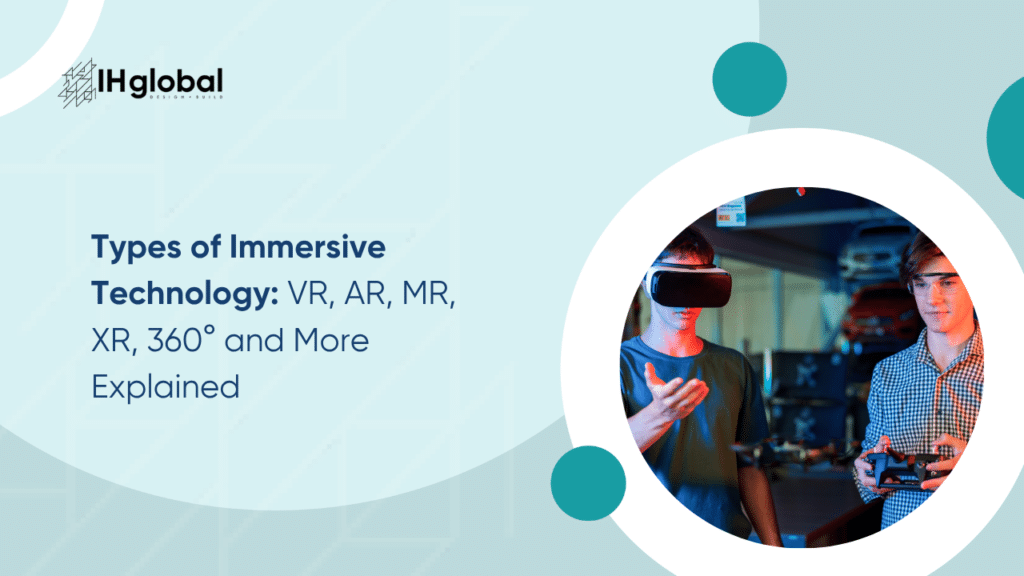
Virtual Reality is the most fully immersive type on the list. When you put on a VR headset, the physical world disappears. Everything you see, hear, and sometimes feel is computer-generated. You are inside a simulation.
VR headsets like the Meta Quest, PlayStation VR, and HTC Vive track your head movements and, in many setups, your hands and body too. The virtual space responds to how you move, which is a big part of what makes it feel real.
Where VR is being used right now:
- Healthcare: Surgeons train on virtual patients before working on real ones.
- Military: Armed forces run battlefield simulations in safe, controlled environments.
- Real estate: Buyers take virtual walkthroughs of properties that have not been built yet.
- Education: Students explore historical sites or the inside of the human body without leaving the classroom.
VR works especially well when real-world mistakes would be too costly or too dangerous. It creates repeatable scenarios where people can practice, fail, and improve without any real-world consequences.
Augmented Reality (AR)
Augmented Reality is different from VR in one important way. It does not replace the real world. It adds to it. Digital content, images, text, 3D models, animations, gets layered on top of what you are already looking at.
AR works through smartphones, tablets, smart glasses, or AR headsets. The camera picks up the real environment, and the software places digital content over it.
Where AR is being used right now:
- Retail: The IKEA app lets shoppers place virtual furniture in their home before they buy.
- Automotive: Technicians wear AR glasses that show step-by-step repair instructions while they work.
- Social media: Snapchat and Instagram filters are one of the most widely used forms of AR in everyday life.
- Navigation: Some driving apps project directions directly onto the road ahead.
AR is one of the most accessible types of immersive technology because most people already own the device it runs on. That makes it far easier and cheaper to deploy at scale than VR.
Mixed Reality (MR)
Mixed Reality sits between AR and VR on the spectrum. Like AR, it keeps you in the real world. But unlike basic AR, digital objects in MR can actually interact with and respond to the physical environment around them.
The difference is subtle but important. In AR, a virtual sofa just floats in your living room. In MR, that virtual sofa understands your floor, your walls, and your real furniture. It casts a shadow.
Where MR is being used right now:
- Manufacturing: Engineers overlay digital assembly instructions onto physical machinery as they work.
- Architecture: Clients see a full-scale model of a building projected into an empty plot of land.
- Medical training: Anatomy holograms appear on a real patient’s body to guide trainees through procedures.
MR needs more processing power and more sophisticated hardware than basic AR. But the experience it delivers is richer and far more convincing.
Extended Reality (XR)
Extended Reality is not a standalone experience. It is the umbrella term that covers all the others. VR, AR, and MR all sit under the XR banner.
When someone uses the term XR, they are talking about the full spectrum of technologies that either extend or replace reality using digital means. It is a useful shorthand for businesses and developers who work across more than one platform and do not want to keep listing every technology separately.
Why XR matters for business:
- It gives teams a single framework for evaluating and discussing immersive technology options.
- It helps communicate strategy without locking into one specific platform.
- As hardware evolves and categories blur, XR as a concept scales with it.
If someone asks about the different types of XR, the short answer is that VR, AR, and MR are the three primary branches, with 360-degree video and haptics often grouped alongside them.
360-Degree Content
360-degree video gets overlooked in a lot of conversations about immersive technology, but it deserves its own spot on the list. It is one of the most widely used formats, especially for storytelling, marketing, and events.
Unlike VR, which is built inside a computer, 360-degree content is filmed with real cameras. Specialist rigs capture footage in every direction at once. When you watch it, you can look up, down, left, and right, as if you are standing in the middle of the scene.
Where 360-degree content is being used right now:
- Tourism and hospitality: Hotels and resorts give potential guests a feel for the property before they book.
- Journalism: News organizations put audiences inside conflict zones or disaster areas.
- Corporate communication: Companies run virtual facility tours or share event highlights.
- Training: Safety teams use 360-degree video to familiarize workers with environments before they arrive on site.
For organizations new to immersive technology, 360-degree content is often the best entry point. Production costs are lower than full VR development, and the content works on smartphones and standard web browsers with no special hardware needed.
Haptic Technology
Haptic technology brings the sense of touch into digital experiences. It is what lets you feel a virtual object, sense resistance in a simulation, or receive physical feedback from a digital interaction.
Most people have experienced basic haptics without realizing it. When your phone vibrates in response to a tap, that is a form of haptic feedback. In immersive technology, haptics go much further than a simple buzz.
Where haptic technology is being used right now:
- Surgical training: Trainee surgeons practice needle insertions on simulators that replicate the feel of real tissue resistance.
- Industrial maintenance: Technicians practice repairs on virtual equipment that pushes back when too much force is applied.
- Gaming and VR: Controllers and vests give players physical feedback when events happen in the game.
- Rehabilitation: Physical therapy tools use haptics to guide patients through recovery exercises.
Haptics add a layer of realism that visuals and audio alone cannot provide. When combined with VR or MR, they significantly improve the quality of training simulations.
Bonus: Digital Twins
A digital twin is a virtual replica of a real-world object, system, or environment. It mirrors the physical thing in real time, using live sensor data to stay current and accurate.
Where digital twins are being used right now:
- Manufacturing: A factory digital twin monitors every machine in real time and flags issues before breakdowns happen.
- Urban planning: City planners model how infrastructure changes will affect traffic and energy before building anything.
- Healthcare: Hospitals use digital twins of facilities to plan patient flow and prepare for emergencies.
- Aviation: Aircraft manufacturers test designs on digital twins before any physical prototype is built.
Comparing the Types: Quick Reference Table
Here is a side-by-side look at the five main types of immersive technology to help you compare them quickly.
| Technology | Reality Status | Key Hardware | Best Use Case | Interactivity |
| Virtual Reality (VR) | Fully replaced | Meta Quest, HTC Vive | Training, simulation, gaming | High |
| Augmented Reality (AR) | Extended with overlays | Smartphone, smart glasses | Retail, navigation, remote support | Medium |
| Mixed Reality (MR) | Extended with holograms | HoloLens, Apple Vision Pro | Engineering, medical, architecture | High |
| 360-Degree Content | Extended (passive viewing) | Smartphone, browser, VR headset | Tourism, journalism, onboarding | Low |
| Haptic Technology | Adds touch feedback | Gloves, controllers, suits | Medical training, industrial sim | High |
Which Type of Immersive Technology Is Right for Your Business?
Choosing the right immersive technology depends on what a business wants to achieve and how it wants to engage its audience.
Different types like VR, AR, MR, XR, 360-degree content, and haptic technology serve different purposes such as training, storytelling, product showcasing, and creating interactive brand experiences in digital and physical spaces.
For B2B industries like exhibitions and environmental graphic design, immersive tools are especially useful in trade shows, booth experiences, and spatial brand storytelling. VR can create full walkthroughs, AR can enhance physical displays with digital layers, and XR can combine both for more engaging visitor experiences.
In simple terms, the best immersive technology is the one that supports clear communication, strong visual impact, and better audience engagement.
In many real-world exhibition and design projects, companies also work with IH Global to apply these technologies in practical and experience-driven environments.
FAQs
What are the main types of immersive technology?
The main types of immersive technology are virtual reality (VR), augmented reality (AR), mixed reality (MR), extended reality (XR), 360-degree content, haptic technology, and digital twins. These technologies create interactive and realistic digital experiences across many industries.
What is the difference between VR, AR, MR, and XR?
VR creates a fully virtual world, AR adds digital elements to the real world, MR mixes real and virtual objects together, and XR is a combination of all immersive technologies. Each offers different levels of digital interaction and immersion.
What type of immersive technology is the most common?
Augmented reality (AR) is the most common immersive technology because it works on smartphones and apps. It is widely used in retail, gaming, education, and navigation to enhance real-world experiences with digital information and interactive visuals.
What is 360-degree immersive technology?
360-degree immersive technology allows users to explore an environment in all directions through images or videos. It creates a realistic viewing experience used in tourism, real estate, and virtual tours without needing full VR headsets or advanced devices.
What is haptic technology and how is it used?
Haptic technology provides touch-based feedback like vibration or pressure in digital systems. It is used in gaming, VR training, medical simulations, and robotics to make virtual interactions feel more real, engaging, and physically interactive for users.
Which type of immersive technology is best for business training?
Virtual reality (VR) and XR are best for business training because they create realistic simulations for employees. They help people practice skills safely, improve learning speed, and build confidence without real-world risks in training environments.
What is a digital twin and is it immersive technology?
A digital twin is a virtual copy of a real-world object or system used for monitoring and analysis. Yes, it is part of immersive technology because it helps visualize real-time data and improve decision-making in industries like manufacturing.
Can different types of immersive technology be combined?
Yes, immersive technologies like VR, AR, MR, and haptics can be combined to create richer experiences. This combination improves training, storytelling, and user engagement by blending real and digital environments for more effective interaction.
What type of immersive technology is best for trade shows and exhibitions?
VR, AR, and XR are best for trade shows and exhibitions because they create interactive brand experiences. They help businesses attract visitors, showcase products in 3D, and improve engagement through immersive storytelling and visual presentations.