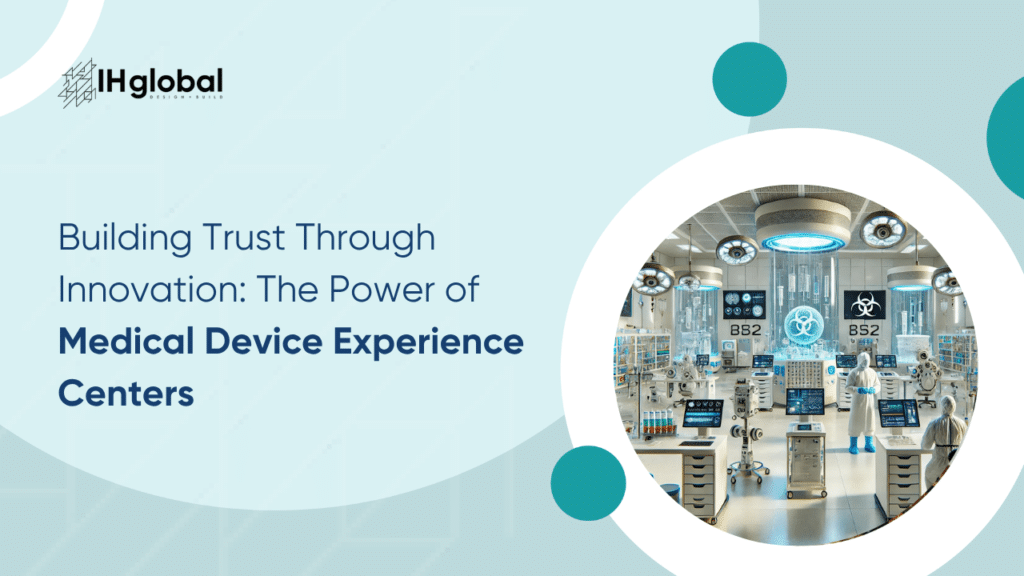
TL;DR
- Medical device experience centers help healthcare professionals understand complex technologies through hands-on demonstrations, simulations, and realistic clinical environment configurations.
- These immersive spaces build clinician confidence, improve hospital procurement decisions, and accelerate product adoption by making medical technology easier to experience and evaluate before deployment.
Research published in PMC (PubMed Central) found that 75.5% of healthcare students and providers report a significant increase in confidence when using new medical technology after hands-on training. In an era where digital transformation in healthcare can feel impersonal and rapid, medical device experience centers bridge the gap between complex engineering and genuine clinical trust.
These are specialised spaces where healthcare professionals — surgeons, ward nurses, procurement directors, and clinical engineers — can test-drive the latest medical technology in a safe, pressure-free environment that mirrors real clinical settings. Rather than reading a product manual or watching a vendor presentation, clinicians get direct hands-on experience before the device is ever used with a patient.
By prioritising transparency, education, and practical demonstration, manufacturers who invest in these centers build lasting clinical partnerships rather than transactional customer relationships. According to the World Health Organization’s guidance on medical devices, appropriate training and evaluation are fundamental prerequisites for safe medical technology adoption — and experience centers are purpose-built to deliver both.
Why Medical Device Experience Centers Are the Future of B2B Healthcare Sales
The healthcare technology sector is undergoing a fundamental shift from transactional selling to experience-based engagement. The complexity of modern medical devices — from AI-assisted diagnostic platforms to robotic-assisted surgical systems — means that a vendor presentation, however polished, is no longer sufficient to build the clinical confidence required for a hospital procurement decision.
By creating a physical space that mirrors the clinician’s daily working environment, medical device companies can address specific clinical pain points in real time. This method ensures that the technology is not just seen — it is understood within the context of actual medical practice. The conversation shifts from product features to clinical outcomes.
Creating a Collaborative Clinical Ecosystem
A well-designed medical device experience center is more than a showroom — it is a collaborative ecosystem built to simulate the full spectrum of real-world clinical challenges that the technology is designed to address.
- When clinicians step into these spaces, they engage with the future of their clinical practice — not a static catalogue.
- Centers allow hospitals to move beyond the ‘what’ of a product and explore the ‘how’: how will this device change our workflow? How does it integrate with our existing infrastructure? How do we train our team?
- This collaborative approach builds the kind of clinical champion relationships that are the primary driver of long-term medical device commercial success.
Explore the future of customer experience centers to understand how healthcare technology brands are positioning these spaces as central to their commercial strategy.
Strategic Benefits of Healthcare Experience Centers for Hospital Decision-Makers
Hospital procurement decisions involve complex stakeholder hierarchies — clinical leads, department heads, procurement officers, hospital administrators, and biomedical engineering teams. Each brings different priorities and concerns to the evaluation process. A well-structured healthcare experience center is designed to address all of them in a single, structured visit.
According to Deloitte’s global healthcare outlook, the average B2B healthcare technology purchase now involves 6 to 8 decision-makers — each requiring a different type of evidence to move toward approval. Experience centers are uniquely capable of serving all these audiences simultaneously.
Immersive Learning in Healthcare Experience Centers
Traditional medical conferences and trade exhibitions are crowded, time-constrained, and rarely provide the depth of technical engagement that clinical leaders require. In contrast, a purpose-built experience center offers a quiet, controlled environment where a Chief of Surgery or Head of Procurement can spend focused time exploring a device’s full capabilities.
- Specialty-Tailored Training: Demonstration programs configured to specific surgical specialties or clinical departments, ensuring relevance to each visitor’s daily practice.
- Peer and Expert Interaction: Structured sessions where visiting clinicians can discuss real cases and clinical techniques with both the manufacturer’s medical experts and peer clinicians who have already adopted the technology.
The Rise of Customer Experience Centers for Medical Device Companies
The growing popularity of customer experience centers among medical device companies reflects a direct response to the complexity of modern healthcare technology. The learning curve for AI-driven diagnostics, robotic-assisted surgery, or connected patient monitoring is steep — and a brochure simply cannot flatten it.
Experience centers provide a dedicated ‘sandbox’ environment where clinical teams can practice safely, fail without consequences, and build genuine competence before the technology enters an operating theatre or an ICU. This risk-free learning environment is one of the most powerful trust-building tools available to medical device companies.
Read 7 key trends in customer experience centers to see how healthcare technology brands are evolving their demonstration environments.
Maximising ROI with Medical Technology Experience Centers
The financial case for medical device experience centers is compelling. The cost of a failed medical device implementation — in terms of clinical disruption, retraining, safety incidents, and procurement reversal — far exceeds the investment in a high-quality demonstration environment. Experience centers reduce implementation risk for both the buyer and the seller.
Feature / Benefit Comparison
| Feature | Clinician Benefit | Hospital Benefit |
| Hands-On Simulation | Mastery of complex tools in a zero-risk clinical simulation environment | Reduced incidence of device-related errors post-implementation |
| Workflow Mapping | Improved ergonomic confidence and comfort during long clinical shifts | Higher patient throughput and optimised clinical pathway efficiency |
| Digital Integration | Seamless familiarisation with data interfaces and clinical UI/UX design | Better patient data continuity and improved clinical outcomes reporting |
Hands-On Innovation at the Medical Technology Experience Center
State-of-the-art medical technology experience centers feature modular clinical environments that can be configured to replicate an ICU, an ER, a hybrid operating theatre, or a specialist diagnostic suite. This level of contextual realism allows procurement teams to evaluate not just whether a device works, but whether it works within their specific clinical environment.
When a procurement director can stand inside a simulation of their own department and see how a new device integrates with existing infrastructure — physically, ergonomically, and informationally — the purchase decision becomes both faster and more confident.
Hospital Equipment Showcase Centers: Visualising the Full Patient Journey
Effective hospital equipment showcase centers tell the complete story of clinical impact — not just product function. The most compelling demonstrations walk hospital executives through the full patient journey: from admission and triage, through diagnosis and treatment, to recovery and discharge. This holistic view is what transforms a procurement discussion from ‘how much does it cost?’ to ‘how much will this improve our care?’
The Patient Journey Through Hospital Equipment Showcase Centers
By structuring the demonstration around the patient pathway rather than the product catalogue, experience centers help hospital executives understand the comprehensive impact of a purchase across the entire care continuum. Key demonstration pillars include:
- Workflow Visualisation: Mapping exactly how a new device changes the clinical workflow — from technician preparation through patient interaction to post-procedure data documentation.
- Safety Simulation: Demonstrating built-in fail-safes, alarm systems, emergency protocols, and regulatory compliance features in a controlled setting.
- Integration Testing: Showing live connectivity between the device and the hospital’s HIS, EMR, and PACS systems — proving clinical data flows without manual re-entry.
Engagement Through Interactive Healthcare Experience Centers
The most effective interactive healthcare experience centers use augmented reality and digital twins to make the invisible visible. AR overlays can show how data flows from a bedside monitor to a central nursing station, how a surgical robot’s movements map to the surgeon’s controller inputs, or how an AI diagnostic tool processes imaging data in real time.
This transparency — the ability to see inside the ‘black box’ of complex medical technology — is what converts clinical sceptics into clinical advocates.
Driving Adoption with High-Fidelity Medical Device Product Demonstrations
The quality of medical device product demonstrations within a dedicated experience center significantly exceeds what is achievable in the field. With on-site clinical applications specialists, perfectly calibrated equipment, and an environment engineered for clarity, the combination of technical proof and ‘how-to’ expertise directly addresses adoption barriers.
Perfecting Medical Device Product Demonstrations
The most effective demonstrations are structured around the specific clinical use cases and concerns of the visiting team. A cardiovascular device demonstration for a cardiac surgery department will focus on different parameters than the same device shown to a hospital procurement team focused on cost-per-procedure analysis.
Explore how technology is transforming customer experience centers to understand how digital twin integration and AI-powered personalisation are reshaping medical device demonstration environments.
Healthcare Technology Visualisation
Clinical trust is built through clarity. Healthcare technology visualisation tools — including 3D anatomical mapping of surgical approaches, AR implant positioning previews, and high-resolution simulation of device-tissue interaction — allow surgeons to see the precise benefits of a device in their own specialty context.
When a surgeon can visualise exactly how an implant sits in a joint via high-resolution rendering, or observe how a robotic system tracks the natural range of joint motion during a simulated procedure, the perceived clinical risk of adoption drops significantly. This is the most powerful accelerator of medical technology adoption available to device manufacturers.
Clinician Engagement Strategies for Long-Term Commercial Partnership
The ultimate goal of any medical device experience center is to move the commercial relationship from a one-time procurement event to a long-term, mutually invested strategic partnership. The most effective clinician engagement strategies achieve this by involving clinical professionals in the improvement and evolution of the technology itself.
When clinicians are invited into structured feedback sessions — able to flag usability issues, suggest workflow improvements, and trial prototype iterations — they develop genuine ownership of the technology’s direction. This co-design relationship creates a depth of commercial loyalty and advocacy that no marketing campaign can replicate.
Explore examples of the world’s most effective customer experience centers to see how leading medical device companies are designing long-term clinical partnership programs into their experience center strategy.
Conclusion
As we move through 2026, the mandate for medical device companies is unambiguous: stop selling products and start providing undeniable clinical experiences. A well-designed medical device experience center does more than display equipment — it acts as a catalyst for clinical trust, operational confidence, and long-term commercial partnership.
At IH Global, we specialise in bringing these visions to life. With deep expertise in experience center design and clinical brand storytelling, we help medical technology companies build world-class facilities that drive clinician engagement, accelerate hospital procurement decisions, and support sustainable adoption at scale.
Ready to build your medical device experience center? View our portfolio or contact our team to begin.
Frequently Asked Questions
What are medical device experience centers?
Medical device experience centers are purpose-built facilities where healthcare professionals — including surgeons, nurses, clinical engineers, and hospital procurement leaders — can interact directly with medical technology in a realistic clinical simulation environment. They go beyond traditional product demonstrations by replicating actual clinical settings, allowing hands-on evaluation of how devices perform within the specific workflows and environments in which they will be used.
Why are experience centers important for medical device companies?
Because the complexity, safety implications, and clinical integration requirements of modern medical devices make traditional sales methods insufficient. Hospital procurement decisions require evidence of real-world clinical performance, workflow compatibility, and training feasibility — all of which can only be adequately demonstrated through hands-on, contextualised experience. These centers provide that evidence while simultaneously building the clinical relationships that drive long-term adoption.
How do medical device experience centers improve clinician training?
They provide a zero-risk, high-fidelity simulation environment where clinical teams can develop genuine competence with new devices before they are ever used in a patient care setting. This includes hands-on procedural practice, workflow integration exercises, and scenario-based training for edge cases and emergency protocols — dramatically improving both clinical readiness and post-implementation safety outcomes.
Can medical device experience centers increase hospital trust?
Yes — and this is one of their most critical commercial functions. By making system behaviour, safety protocols, failure modes, and integration capabilities fully transparent through live demonstration, experience centers address the risk perception that is the single biggest barrier to hospital adoption of new medical technology. Trust is built through direct evidence, not specification claims.
How do medical device companies improve product adoption through experience centers?
By removing the three primary adoption barriers: uncertainty about clinical performance, concerns about workflow disruption, and uncertainty about training requirements. Experience centers address all three simultaneously — providing direct performance evidence, demonstrating workflow integration in a realistic setting, and delivering hands-on training in a structured program. Companies that invest in these centers consistently achieve faster adoption cycles and better post-adoption retention.
What ROI can medical device companies expect from experience centers?
The commercial ROI comes from multiple directions: shorter average procurement cycles (from reduced stakeholder uncertainty), higher average deal values (as buyers gain confidence in premium capabilities), lower post-sale support costs (from better pre-sale training), and improved clinical champion relationships (which drive both repeat purchases and referral business). The strategic ROI — in terms of regulatory positioning, clinical data generation, and product development feedback — can be equally significant.