Choosing the right display technology can significantly affect how an event looks and feels. Two common options are LED walls and projection mapping, but they solve different problems.
An LED wall creates a bright, high-resolution digital surface using individual LED panels. Projection mapping uses projectors to transform a physical surface, object, stage, or building into a dynamic visual canvas.
The choice between LED wall vs projection mapping depends on your venue, lighting conditions, content, available space, budget, and the type of experience you want to create.
TL;DR
- LED walls provide bright, high-impact visuals and work well when ambient light cannot be fully controlled.
- Projection mapping can transform stages, products, structures, and unusual surfaces into dynamic visual experiences.
- LED walls generally require a higher hardware investment, while projection mapping costs depend heavily on projectors, surface size, content complexity, and technical setup.
- Outdoor daytime events generally favour appropriately specified LED walls, while projection mapping can be effective when the environment and lighting can be controlled.
- The two technologies can also be combined, with LED providing a reliable digital canvas and projection adding mapped visual effects.
LED Walls: Strengths and Limitations
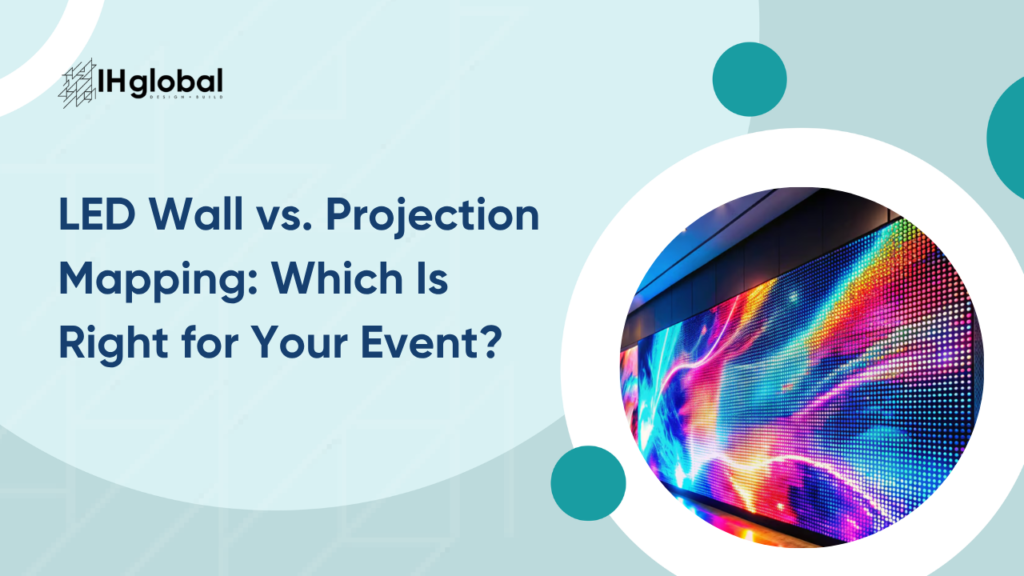
An LED wall is made from modular LED panels that form a large digital display. Unlike projection, the LED panels produce their own light, which makes them highly visible in bright environments.
Strengths of LED Walls
High brightness: LED walls can maintain strong visibility in environments with substantial ambient light. This makes them useful for exhibition halls, corporate events, outdoor activations, and venues where lighting cannot be fully controlled.
Strong visual impact: A large LED wall can become the central visual element of a stage or exhibition stand. Content can include videos, animations, presentations, live feeds, product visuals, and branded graphics.
Flexible content: Content can be changed without replacing the physical display. This can be useful for multi-day exhibitions where different messages need to be shown throughout the event.
Suitable for outdoor applications: Outdoor-rated LED systems can be specified for events where weather exposure and daylight are considerations.
No projection surface required: Because the LED panels themselves form the display, there is no need to project onto a separate screen or physical structure.
For large exhibitions and corporate events, LED wall and video wall solutions can also be structurally integrated into a stage or exhibition stand.
Limitations of LED Walls
LED walls can require a significant investment, particularly when using large surfaces, fine pixel pitches, curved configurations, or custom structures.
They also have physical depth and weight. Structural support, power, rigging, installation, and content specifications need to be considered during planning.
Most importantly, an LED wall remains a display surface. It does not naturally conform to a three-dimensional object or architectural structure in the same way that projection mapping can.
Projection Mapping: Strengths and Limitations
Projection mapping uses one or more projectors to display specially produced visuals onto a physical surface. The content is precisely aligned with the shape and dimensions of that surface.
Instead of simply displaying an image on a rectangular screen, projection mapping can make a building facade, product, vehicle, stage element, or three-dimensional object appear to transform.
Strengths of Projection Mapping
Works with physical surfaces: Projection mapping can use architecture, products, stages, exhibition structures, and other objects as part of the visual experience.
Creates immersive storytelling: Content can be designed to interact visually with the shape of the surface, creating effects such as movement, transformation, reveals, and simulated changes in texture.
Useful for unusual shapes: A curved or irregular physical structure does not have to be replaced by a conventional rectangular display.
Strong creative flexibility: Projection mapping is particularly useful for launches, ceremonies, stage shows, exhibitions, and brand activations where visual storytelling is central to the experience.
For example, IH Global’s projection mapping services cover building facades, products, objects, stages, and exhibition environments.
Limitations of Projection Mapping
Projection mapping depends heavily on the environment.
Ambient light can reduce contrast and make projected visuals less visible. For this reason, dark or controllable environments are generally more suitable for projection mapping than bright outdoor conditions.
The physical surface also needs to be considered carefully. Projector position, throw distance, surface geometry, alignment, and obstructions can all affect the final result.
Projection mapping also requires content that is specifically produced for the mapped surface. A conventional video cannot simply be placed onto a complex three-dimensional object and expected to align correctly.
Side-by-Side Comparison
The difference between LED wall and projection mapping becomes clearer when you compare how each technology handles common event requirements.
| Factor | LED Wall | Projection Mapping |
| Basic principle | LED panels produce the image directly | Projectors cast visuals onto a physical surface |
| Bright environments | Strong performance | More affected by ambient light |
| Outdoor daytime use | Suitable with appropriate outdoor rated equipment | Generally challenging in strong daylight |
| Three dimensional surfaces | Limited to the physical shape of the LED structure | Can map directly onto three dimensional objects and structures |
| Creative surface transformation | Requires custom LED structure | One of its main strengths |
| Content flexibility | High | High, but content must be mapped to the surface |
| Setup requirements | Panels, structure, power, processing, and calibration | Projectors, mounting positions, mapping, alignment, and content |
| Large rectangular display | Highly suitable | Suitable, but may not be the most efficient approach |
| Architectural storytelling | Limited | Highly suitable |
| Typical visual strength | Bright, crisp digital display | Immersive transformation of physical surfaces |
Neither technology is automatically better. The LED wall or projection mapping decision should be based on what the display needs to accomplish.
Cost Comparison
There is no universal price difference because both technologies can vary considerably in scale and specification.
An LED wall’s cost is influenced by factors such as:
- Screen size
- Pixel pitch
- Indoor or outdoor specification
- Curved or custom-shaped configuration
- Structural support
- Installation and rigging
- Content requirements
- Rental or permanent installation
Projection mapping costs can depend on:
- Number and brightness of projectors
- Projection surface size
- Surface complexity
- Throw distance
- Content production
- Mapping and alignment
- Installation and technical support
- Venue lighting conditions
In general, a simple projection setup can be less expensive than a comparable large LED display, but projection mapping is not simply a cheaper substitute for an LED wall. Once multiple high-output projectors, specialised content, mapping, rigging, and technical operation are involved, the overall project can become considerably more complex.
The most useful comparison is therefore the total cost of delivering the required experience, rather than the rental price of the display hardware alone.
Which Should You Choose? A Decision Guide
The simplest way to decide between the two is to start with the venue and experience.
Choose an LED Wall When:
- The venue has significant ambient light.
- You need strong visibility during daytime.
- The event is outdoors.
- You need a large, conventional digital backdrop.
- Content includes presentations, live feeds, videos, or changing graphics.
- You need the display to remain consistently visible throughout the event.
- The audience will be relatively close to the screen and pixel pitch needs to be selected accordingly.
Choose Projection Mapping When:
- You want to transform a physical object or structure.
- The event takes place in a dark or controllable environment.
- Visual storytelling is more important than simply displaying content.
- You are mapping a building, product, vehicle, stage, or unusual surface.
- You want the physical environment itself to become part of the experience.
- The creative concept depends on simulated movement, transformation, or architectural effects.
If the project combines several technologies, IH Global’s experiential technology solutions can bring LED, projection mapping, interactive installations, holographic displays, and event technology together within one experience.
Can You Use Both Together?
Yes. LED walls and projection mapping can be combined when each technology has a different role.
For example, an event could use an LED wall as the primary stage display while projection mapping is used on physical scenic elements surrounding it.
A product launch could place the product itself at the centre of a projection-mapped reveal while an LED wall provides supporting product information, branding, or live event content.
The combination can also help separate reliable information delivery from immersive visual storytelling. The LED wall handles content that needs consistent brightness and legibility, while projection mapping adds depth and transformation to the physical environment.
This approach requires careful content design and technical coordination so that the different surfaces feel like one visual experience rather than separate displays.
For activations involving multiple interactive or visual technologies, event technology solutions can help coordinate the technical elements as part of the wider event setup.
Conclusion
The choice between LED wall vs projection mapping ultimately comes down to the experience you need to create.
LED walls are well suited to bright environments, large digital backdrops, outdoor events, exhibitions, and situations where consistent visibility is important. Projection mapping is better suited to transforming physical surfaces and creating immersive visual storytelling in environments where lighting can be controlled.
Cost should also be considered alongside venue conditions, content requirements, installation, technical support, and the complexity of the experience.
For some events, there is no need to choose just one. Combining an LED wall with projection mapping can create a layered environment where digital content and physical surfaces work together.
Frequently Asked Questions
What is the difference between an LED wall and projection mapping?
An LED wall uses individual LED panels to produce a large digital display. Projection mapping uses projectors to cast specially created visuals onto a physical surface, allowing objects, stages, buildings, and other structures to become part of the visual experience.
Which is more expensive — LED wall or projection mapping?
The answer depends on the scale and specification. LED wall costs depend on screen size, pixel pitch, structure, installation, and equipment. Projection mapping costs depend on projector requirements, surface complexity, content production, mapping, installation, and technical support. A simple projection setup can cost less than an LED wall, but complex projection mapping can require significant equipment and production.
Which works better outdoors, LED walls or projection mapping?
LED walls are generally more suitable for outdoor events, particularly when the event takes place during daylight. Outdoor-rated LED systems can be specified for brightness and weather conditions. Projection mapping is more dependent on darkness and controlled ambient light, making it more challenging in bright outdoor environments.
Can LED walls and projection mapping be combined in the same event?
Yes. An LED wall can provide the main digital display while projection mapping transforms surrounding stages, products, structures, or scenic elements. Combining them can create a more layered visual experience when the content and technical setup are designed together.
Which technology is better for exhibition stands?
It depends on the exhibition stand’s objective. LED walls are useful when a stand needs a bright, high-visibility display for videos, presentations, product content, or branding. Projection mapping can be more suitable when the stand incorporates a physical object or structure that the brand wants to transform into an interactive or immersive visual element.