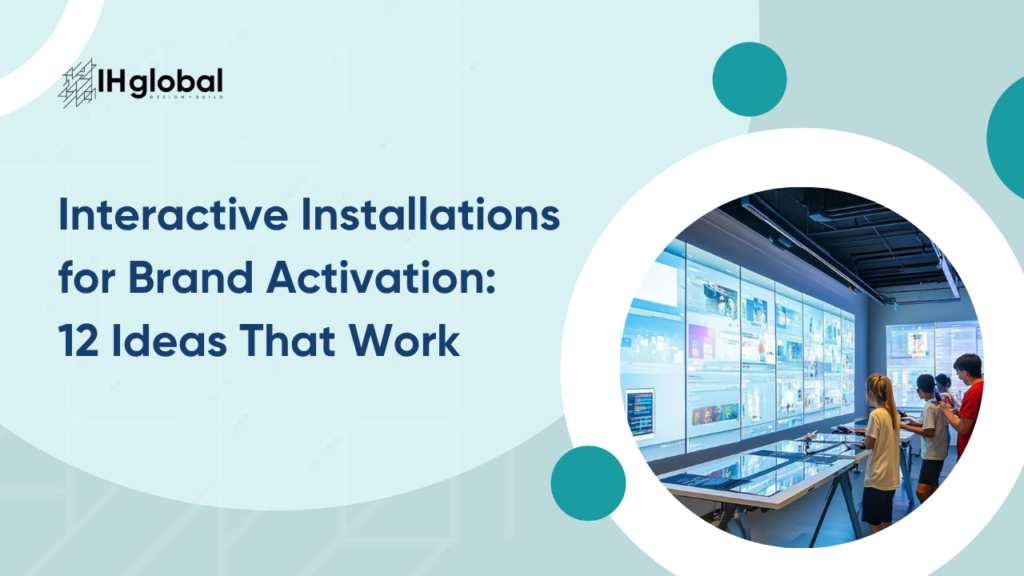
Interactive installations can turn a conventional brand display into an experience that invites people to participate rather than simply look. From touchscreen walls and interactive product displays to motion sensors and gesture-controlled experiences, brands can use experiential technology to create more memorable activations.
For exhibitions, launches, retail spaces, and corporate events, the right interactive installation can encourage engagement while also communicating the brand message. The format you choose, however, should match your audience, venue, campaign objective, and available space.
This guide covers 12 practical interactive installation ideas across touch, motion, gesture, and social experiences.
TL;DR
- Interactive installations encourage audiences to participate rather than simply view a brand display.
- Touchscreens, motion sensors, gesture controls, and social features can create different types of engagement.
- The best format depends on your campaign objective, audience, venue, content, and budget.
- Small exhibition booths can use compact interactive displays without requiring a large installation footprint.
- Interactive experiences can work equally well for B2B brands, especially for product demonstrations, data visualisation, and lead generation.
Why Interactive Installations Outperform Static Displays
A static display communicates information, but an interactive installation gives visitors something to do.
Instead of reading a product description on a conventional panel, visitors can explore features on a touchscreen. Instead of watching a video passively, they can control what appears on the screen. Sensors can also allow an installation to respond to movement, creating an experience that changes according to the visitor’s actions.
This difference can be particularly useful at busy exhibitions and brand activations, where several companies compete for attention.
Interactive experiences can also make complex information easier to explore. A B2B technology company, for example, could use an interactive visualisation to demonstrate how its platform works rather than relying only on printed information.
The technology itself should not be the main attraction, though. Effective brand activation technology supports a clear campaign objective and makes the brand message easier to experience or understand.
For more complex experiences, interactive installation design can combine interactive technology with visual content, physical environments, and other experiential elements.
12 Interactive Installation Ideas for Brand Activation
The following ideas cover different levels of interaction, from simple touchscreen experiences to installations designed specifically for social sharing.
1–3. Touch-Based Installations
1. Interactive Touchscreen Product Explorer
A touchscreen can allow visitors to explore a product at their own pace.
Users can tap different product components, view features, compare models, watch demonstrations, or explore technical specifications. This works particularly well when a product has multiple features that would be difficult to explain through a static display.
For B2B brands, the same format can be used to explain complex services, platforms, or solutions.
2. Interactive Touchscreen Wall
A large touchscreen wall can turn an entire display surface into an interactive experience.
Visitors can navigate through brand stories, product portfolios, timelines, videos, maps, or visual content. This is one of the more flexible touchscreen installation ideas because the same physical display can support different types of content.
At an exhibition, for example, visitors could select a product category and immediately explore relevant information without waiting for a staff member.
3. Interactive Digital Quiz or Survey
A touchscreen quiz can turn audience participation into a simple game.
Visitors can answer questions related to a product, industry, or campaign theme and receive a result at the end. The experience can also be connected to lead collection when appropriate.
The key is to keep the interaction short and easy to understand. A complicated questionnaire can discourage participation, particularly in a busy exhibition environment.
4–6. Motion & Sensor-Based Installations
4. Motion-Responsive Display
Motion sensors can allow projected or digital content to react when visitors move around an installation.
For example, a visitor could approach a display and trigger an animation, product information, or visual transformation. This creates a more dynamic experience without requiring the visitor to touch a screen.
Motion-responsive installations can be particularly effective when brands want the display to attract attention from people passing nearby.
5. Interactive Projection Floor
An interactive projection floor uses cameras or sensors to detect movement and respond with projected visuals.
Visitors might walk through changing graphics, trigger animations with their footsteps, or interact with a virtual environment.
This format can work well for experiential zones where the objective is to create a visually engaging environment rather than simply present product information. It can also be combined with projection mapping solutions when projection is part of a larger branded environment.
6. Sensor-Based Product Experience
Sensors can also be integrated directly into a product display.
When a visitor approaches, touches, lifts, or moves an object, the surrounding screen or projection can respond with relevant information.
For example, a visitor examining a particular product could trigger a visual explanation of its features. This connects physical interaction with digital content and can be useful for retail displays, showrooms, and exhibitions.
7–9. Gesture-Controlled Installations
7. Gesture-Controlled Product Explorer
Gesture recognition allows visitors to control digital content without touching a physical screen.
Hand movements can be used to rotate a 3D product model, move between screens, zoom into features, or trigger animations.
This can be particularly useful where brands want a futuristic experience or want to reduce physical contact with the display.
8. Gesture-Controlled Digital Wall
A large digital wall can respond to hand movements, allowing visitors to navigate through images, videos, information, or brand content.
For example, a visitor could move their hand across the display to reveal different stages of a product’s development or explore different sections of a brand story.
The interaction should remain intuitive. If visitors need detailed instructions before they can understand how to control the installation, the technology can become a distraction rather than an enhancement.
9. Virtual Try-On or Configuration Experience
Gesture controls can also be combined with cameras and digital visualisation to create virtual product experiences.
Visitors can explore different colours, configurations, designs, or product options and see the changes immediately on screen.
This approach can be particularly useful for automotive, fashion, consumer electronics, furniture, and other industries where product customisation is important.
10–12. Social & Shareable Installations
10. Interactive Photo Experience
An interactive photo installation can let visitors create personalised images using branded digital backgrounds, effects, or animations.
The experience can be designed around the campaign theme and provide visitors with a digital asset they can share after interacting with the installation.
The most effective versions make the brand part of the experience without making the result feel like a conventional advertisement.
11. Social Media Content Generator
A brand can create an installation that generates customised social content based on visitor interaction.
Visitors might answer a few questions, select an option, or interact with a visual installation before receiving a personalised image or short video.
This gives the visitor a reason to continue the experience after leaving the physical activation and can extend the campaign beyond the event itself.
12. Interactive Brand Story
An interactive brand story allows visitors to choose what they want to explore rather than following a fixed presentation.
A visitor could select a company’s history, sustainability initiatives, products, milestones, or future plans from an interactive interface.
For exhibitions and corporate events, this can turn a large amount of information into a more manageable and engaging experience.
How to Choose the Right Interactive Format for Your Brand
There is no single format that works for every brand activation. Start with the objective rather than the technology.
Define what you want visitors to do. Do you want them to learn about a product, generate leads, explore information, create social content, or simply engage with the brand?
Consider your audience. A technical B2B audience may respond well to product configurators and data visualisation, while a consumer activation may focus more heavily on games, personalisation, or shareable content.
Assess the venue. Available floor space, screen size, lighting, power, visitor flow, and internet connectivity can all influence the installation.
Match the technology to the content. A touchscreen does not automatically make an experience interactive. The content should be designed around the way visitors will interact with it.
Think about visitor flow. If an experience takes several minutes, make sure the space can accommodate people waiting to use it. For high-traffic events, shorter interactions may work better.
Plan for technical support. Interactive installations involve hardware, software, sensors, displays, and content. On-site technical support can help resolve issues during the activation.
For larger activations involving multiple technologies, event technology solutions can help bring different elements together within one experience.
Conclusion
Interactive installations can make brand activations more engaging by giving audiences an active role in the experience. Touchscreens, motion sensors, gesture controls, and social features each offer different ways to encourage participation.
The most effective installation is not necessarily the most technologically advanced one. It is the format that fits the brand objective, audience, venue, content, and visitor journey.
Whether you are planning a large experiential campaign or looking for interactive exhibition ideas for a smaller booth, the installation should make it easier for visitors to understand, explore, or remember the brand.
For brands combining interactive technology with physical exhibition or event environments, IH Global’s experiential technology solutions can bring the technology, content, and physical experience together.
Frequently Asked Questions
What are good interactive installation ideas for a brand activation?
Touchscreen product explorers, interactive walls, digital quizzes, motion-responsive displays, projection floors, gesture-controlled interfaces, virtual configurators, and social content generators are all potential formats. The right choice depends on the campaign objective and audience.
How do I choose the right interactive installation for my event?
Start by defining what you want visitors to do. Then consider your audience, venue, available space, content, visitor flow, budget, and technical requirements. The technology should support the campaign objective rather than be used simply because it is available.
What is the most cost-effective interactive installation format?
Simple touchscreen experiences are often more straightforward to implement than larger sensor-based, projection, or gesture-controlled installations. However, the final cost depends on hardware, software, content development, installation, and technical support.
Can interactive installations work in a small exhibition booth?
Yes. Compact touchscreen displays, interactive product explorers, tablet-based experiences, and smaller sensor-based installations can work within limited spaces. The experience should be designed around the available footprint and visitor flow.
Do interactive installations work for B2B brands, not just consumer brands?
Yes. B2B brands can use interactive installations for product demonstrations, service explanations, data visualisation, product configuration, lead generation, and technical presentations. Interactive experiences can make complex B2B offerings easier for visitors to explore.