Tl,dr:
- Construction brands are replacing traditional showrooms with immersive experience centers that use AR, VR, live demos, and interactive displays to help clients visualize real-world applications
- These experience centers improve B2B engagement, speed up decision-making, and strengthen brand trust by combining technology, storytelling, and hands-on product interaction
Introduction
For years, construction brands relied on traditional showrooms—static aisles of tiles and fixtures that left much to the imagination. Today, the industry is moving “beyond the tile” toward Experience Centers: immersive hubs that use technology to bring projects to life before construction even starts.
This shift is driven by a demand for better visualization. Research highlights that immersive technologies like VR and AR can significantly boost productivity and safety by identifying design issues early.
But the real question is: how it works within a complex ecosystem.
The Limitations of Traditional Showrooms
Traditional showrooms served a simple purpose: physical verification. However, they often lacked context. A buyer looking at a slab of marble in a showroom might struggle to visualize it in a high-traffic hotel lobby.
This disconnect often leads to “buyer’s remorse” or prolonged decision-making cycles. By moving toward construction experience centers, brands are eliminating this guesswork through immersive storytelling.
let’s understand better with an example
Example: Instead of just looking at a stack of insulation boards, a visitor enters a “thermal chamber” where they can feel the temperature difference between a standard wall and one treated with the brand’s high-performance insulation.
What Sets Experience Centers Apart?
The primary difference lies in engagement. While showrooms are passive, construction experience centers are active. They utilize cutting-edge technology such as Augmented Reality (AR) and Virtual Reality (VR) to provide an Immersive Customer Experience in Construction.
How these centers redefine engagement:
- Live Stress Testing: Demonstrating how materials perform under extreme pressure or weather conditions using live rigs.
- Digital Overlays: Using AR tablets to show the internal plumbing or wiring hidden behind a finished wall panel.
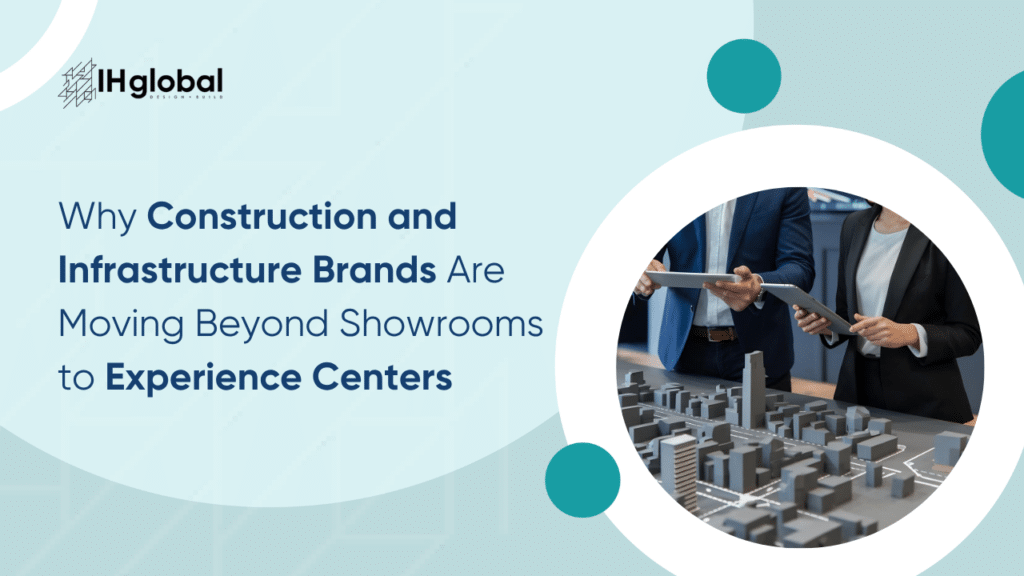
- Scale Modeling: 3D-printed miniature cityscapes that show how a specific infrastructure material integrates into an urban environment.
For high-stakes projects, infrastructure brand experience centers serve as a proof-of-concept hub. These spaces allow engineers and architects to test material durability and integration before a single brick is laid on-site.
The Rise of B2B Engagement
In the professional sector, B2B Experience Centers are becoming essential for closing large-scale contracts. Decision-makers in the infrastructure world are looking for reliability and long-term partnerships. An experience center allows a brand to showcase its manufacturing prowess, its commitment to R&D, and its post-sales support infrastructure. This holistic approach is a cornerstone of modern Construction Brand Engagement.
By shifting from a transactional environment to an educational one, companies can position themselves as thought leaders. There are several reasons why tech and infrastructure companies need a Customer Experience Center to remain competitive.
Technology Integration: The New Standard
A key feature of modern construction experience centers is the integration of “Phygital” (Physical + Digital) elements. Sensors, touch-interactive walls, and 3D projection mapping turn Construction Product Display Centers into interactive laboratories.
Essential Tech Pointers for Modern Centers:
- Interactive Material Libraries: RFID-tagged samples that, when placed on a smart table, trigger a screen showing the product’s carbon footprint and origin.
- Acoustic Zones: Soundproof pods that allow architects to hear the decibel-dampening effects of different acoustic ceiling tiles.
- Lighting Simulators: Rooms that mimic natural light from sunrise to sunset to show how facade materials change appearance throughout the day.
To see how these elements come together in high-stakes environments, refer to this ultimate guide to B2B manufacturing marketing.
Human-Centric Design in Construction
At the heart of every construction experience centers strategy is the human element. Brands are no longer just selling “cement” or “steel”; they are selling the dream of a skyscraper or the safety of a family home. By creating curated journeys within these spaces, brands can tap into the emotional drivers of their clients. This evolution is detailed further in our latest insights on experiential marketing trends.
The investment in construction experience centers also pays off in the form of social proof. These visually stunning, high-tech spaces are “Instagrammable” and shareable, providing organic marketing reach that traditional showrooms lack.
Conclusion
The construction and infrastructure sectors are often perceived as slow-moving, but the shift toward construction experience centers proves otherwise. As the market becomes more competitive, the ability to provide an immersive, educational, and technologically advanced environment will be the ultimate differentiator.
Brands that continue to rely solely on traditional displays risk being left behind by a generation of buyers who value experience as much as the product itself.
The move toward construction experience centers is not just a trend, it is the new blueprint for success in the built environment. For more industry-leading perspectives, check out IH Global.
FAQS
What are Construction Experience Centers?
Construction Experience Centers are immersive spaces that use AR, VR, and live demos to showcase products. IH Global creates engaging experience centers for modern construction brands.
Why are brands moving beyond traditional showrooms?
Traditional showrooms lack real-world visualization. IH Global helps brands deliver interactive and immersive customer experiences.
How do Experience Centers improve customer engagement?
Experience Centers use technology and storytelling to create stronger customer connections. IH Global designs immersive spaces that improve engagement and trust.
What technology is used in Construction Experience Centers?
AR, VR, touch displays, and projection mapping are commonly used. IH Global integrates advanced technology into experience center design.
Why are B2B Experience Centers important?
B2B Experience Centers help brands showcase product quality and innovation interactively. IH Global builds customized solutions for infrastructure and construction brands.