Tl,dr:
B2B Automotive Customer Experience Centers help brands replace traditional sales pitches with immersive demos, digital twins, and interactive mobility solutions that build trust faster
These centers accelerate decision-making by allowing stakeholders to experience real-time data, ROI simulations, and collaborative innovation in one space
Introduction
Did you know that in the modern B2B, the average buying group spends only 17% of their total journey actually meeting with potential suppliers? According to research by Gartner, this means if you are competing against two other vendors, your brand might only have a narrow 5% window to make a lasting, face-to-face impression.
In the high-stakes automotive industry, where sales involve multi-million dollar contracts and complex engineering, this “efficiency gap” has given rise to a powerful new weapon: the B2B automotive customer experience center. These centers are the industry’s response to a world where a PDF brochure is no longer enough to close a deal.
This shift is not limited to the automotive sector alone.
For many organizations, understanding why tech companies need a customer experience center is the first step toward transforming their sales pipeline.
How Is the Product Pitch Turning Into an Immersive Experience?
For decades, B2B sales relied on technical specifications and PowerPoint decks. However, mobility solutions today often involve intricate software layers, cloud integration, and complex infrastructure.
B2B automotive customer experience center provide a physical and digital space where stakeholders, from fleet managers to city planners, can interact with these solutions firsthand.
By utilizing B2B experiential marketing for automotive, brands can move away from passive selling. Instead of hearing about a new fleet management system, a client can sit in a cockpit, toggle real-time data feeds, and witness the immediate impact of the technology on operational efficiency.
This shift from “telling” to “showing” is a cornerstone of modern customer experience strategies, building a level of trust that a PDF simply cannot achieve.
But how are automotive brands taking these immersive experiences a step further for enterprise buyers?
The answer is “Digital twin”
Why Are Digital Twin Automotive Demos Important?
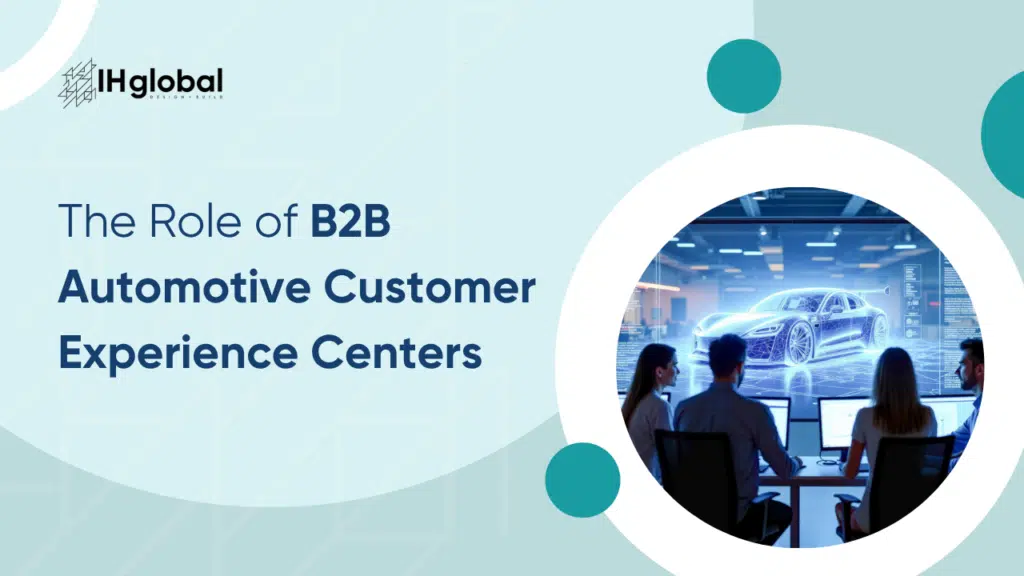
One of the most transformative elements within these centers is the integration of digital twin automotive demos. A digital twin is a virtual replica of a physical asset or system. In a B2B sales context, this allows potential buyers to stress-test solutions in a virtual environment that mimics their specific real-world conditions.
Let’s understand this by an example
For example, a logistics company considering a transition to electric trucks can use a digital twin to simulate how those vehicles will perform in different climates or across specific topographies.
This data-driven immersion is why many experts believe that experience centers are the next curve for your brand. By reducing the perceived risk of investment, B2B automotive customer experience center become indispensable for high-value decision-making.
How Do Interactive Mobility Innovation Hubs Create Collaboration?
Modern mobility isn’t just about the vehicle; it’s about the ecosystem. Interactive mobility innovation hubs serve as collaborative environments where manufacturers and clients can co-create. These hubs often feature:
- Modular Displays: Visualizing how hardware integrates with third-party software.
- VR/AR Zones: Allowing engineers to “walk through” the internal architecture of a vehicle.
- Real-time Analytics Walls: Displaying live data from existing global deployments.
This level of immersion is essential because, much like in heavy industry, buyers need to experience systems before they invest significant capital.
By positioning themselves as partners, companies using B2B automotive customer experience center foster long-term relationships.
How Do B2B Automotive Experience Centers Accelerate Decision-Making?
The B2B sales journey in the automotive sector is notoriously long. The primary goal of these sophisticated spaces is accelerating B2B sales cycles. When all stakeholders, procurement, engineering, and C-suite executives, are brought into a unified environment, questions that usually take weeks of emails can be answered in minutes.
Much like how a manufacturing CEC shortens the sales cycle, these facilities provide the “Aha!” moment faster. When a CFO can see the ROI dashboard in real-time, B2B automotive customer experience center act as a shortcut through the noise, providing the clarity needed to move to a “yes.”
Redefining the Traditional Showroom
While consumer-facing dealerships are evolving, mobility solution showrooms for the B2B sector are setting a new standard for professional engagement.
Unlike retail spaces, these showrooms are tailored to the “Jobs to be Done” of a business client, focusing on uptime, total cost of ownership (TCO), and regulatory compliance.
Within these B2B automotive customer experience center, the narrative is always focused on the client’s pain points. Whether it’s solving last-mile delivery or integrating V2G (Vehicle-to-Grid) technology, the showroom provides a controlled environment to demonstrate reliability.
To achieve this, companies often work with top customer experience agencies to ensure the journey is seamless.
The Future of B2B Automotive Sales
As we move toward 2030, the reliance on B2B automotive customer experience center will only grow. As vehicles become “computers on wheels,” the sales process must become a tech consultation. Companies that invest in these centers are not just selling a product; they are selling a vision of a connected future.
By using B2B automotive customer experience center, industry leaders ensure they stay at the forefront of the mobility revolution. Integrating these centers with broader trade show marketing strategies ensures a consistent brand message across all touchpoints, turning complex technical hurdles into profitable customer journeys.
Key Benefits at a Glance
| Feature | Impact on B2B Sales |
| Hands-on Interaction | Increases product understanding and buyer confidence. |
| Data Simulation | Proves ROI through customized, real-world scenarios. |
| Stakeholder Alignment | Groups all decision-makers in one immersive environment. |
| Brand Authority | Positions the seller as a tech leader, not just a manufacturer. |
Conclusion
B2B automotive customer experience center have redefined high-stakes sales by replacing speculation with certainty. By integrating physical touchpoints with digital intelligence, these centers allow manufacturers to demonstrate ROI and reliability in a single visit.
As the industry evolves, the B2B automotive customer experience center will remain the essential venue for turning visionary technology into long-term commercial partnerships.
Faqs
What is a B2B automotive customer experience center?
A B2B automotive customer experience center is an immersive space where brands showcase mobility technologies through live demos, VR, AR, and interactive simulations. IH Global designs these centers to improve enterprise engagement and product understanding.
Why are automotive brands investing in experience centers?
Automotive brands use experience centers to simplify complex sales and create hands-on buyer experiences. IH Global helps brands build spaces that improve trust and decision-making.
What are digital twin automotive demos?
Digital Twin demos create virtual simulations of vehicles and mobility systems for testing performance and ROI. IH Global integrates these experiences into automotive customer engagement strategies.
What technologies are used in automotive experience centers?
These centers use VR, AR, AI dashboards, interactive walls, and real-time analytics. IH Global combines these technologies to deliver immersive automotive experiences
How are B2B automotive showrooms different from dealerships?
B2B automotive showrooms focus on enterprise mobility, fleet operations, and connected ecosystems instead of retail vehicle sales. IH Global designs these environments for business-focused engagement.