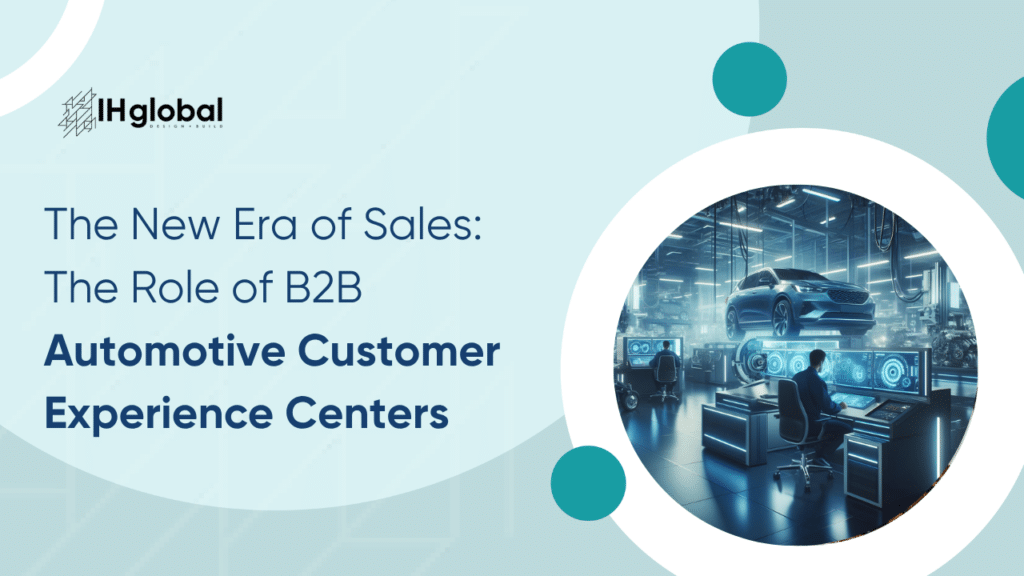
TL;DR
- B2B automotive customer experience centers help brands replace traditional sales presentations with immersive demonstrations — using digital twins, interactive mobility solutions, and real-time ROI simulations — that build buyer trust faster and more durably.
- These centers accelerate complex B2B sales cycles by aligning all stakeholders — procurement, engineering, and C-suite — within a single immersive environment, compressing months of evaluation into hours of direct experience.
According to research by Gartner on the B2B buying journey, the average B2B buying group spends only 17% of their total purchasing journey actually meeting with potential suppliers. For companies competing against two or more alternatives, that translates to a window of approximately 5% of the buyer’s process to make a lasting, face-to-face impression.
In the high-stakes automotive B2B sector — where contracts involve multi-million dollar fleet commitments, complex charging and telematics infrastructure, and long-term service agreements — this efficiency gap has given rise to a powerful commercial tool: the B2B automotive customer experience center. These facilities are the industry’s response to a world in which a PDF brochure and a PowerPoint deck are no longer sufficient to win enterprise mobility contracts.
For organisations seeking to understand the broader commercial context, why technology and mobility companies need a customer experience center provides a compelling framework for this strategic investment.
How the Product Pitch Has Evolved Into an Immersive Experience
For decades, B2B automotive sales relied on technical specification documents, competitive comparison sheets, and demonstration drives. This approach worked reasonably well when purchase decisions were centred on a single vehicle type with straightforward performance characteristics.
Today, enterprise mobility solutions involve intricate software layers, cloud-based fleet management infrastructure, over-the-air update protocols, V2G (vehicle-to-grid) integration, and complex total-cost-of-ownership modelling across multi-year deployment horizons. According to McKinsey’s Future of Mobility research, the increasing software and connectivity complexity of modern commercial vehicles means that traditional product-centric selling is fundamentally inadequate for enterprise buyers.
B2B automotive customer experience centers provide the physical and digital environment where stakeholders — from fleet managers and logistics directors to city planners and infrastructure developers — can interact with these complex solutions firsthand. Rather than hearing about a new fleet management system, a client sits in an operator cockpit, toggles live data feeds, and witnesses the immediate operational impact of the technology on fleet performance metrics.
This shift from ‘telling’ to ‘showing’ is the foundation of modern customer experience strategies that drive the highest commercial engagement rates in B2B automotive markets.
Why Digital Twin Automotive Demonstrations Are a Game-Changer
One of the most commercially transformative elements within automotive experience centers is the integration of digital twin demonstration technology. A digital twin is a dynamic virtual replica of a physical asset or operational system — updated in real time with sensor data from its physical counterpart.
In a B2B sales context, digital twins allow potential buyers to stress-test mobility solutions under conditions that precisely replicate their own operational environment. A logistics company evaluating a transition to electric heavy trucks can use a digital twin to simulate how those vehicles will perform across their specific route profiles, at different payload capacities, in different seasonal temperature conditions, and under varying grid carbon intensity scenarios.
This data-driven simulation addresses the most fundamental concern of enterprise fleet buyers: investment risk. When a CFO can see ROI projections generated from a live operational simulation — not a vendor spreadsheet model — the perceived risk of a major fleet transition drops dramatically. This is precisely why experience centers have become the next competitive curve for automotive brands, redefining what ‘proof of value’ means in high-stakes B2B mobility sales.
How Interactive Mobility Innovation Hubs Create Collaborative Partnerships
The most commercially advanced automotive experience centers function not as sales showrooms but as interactive mobility innovation hubs — collaborative environments where manufacturers and enterprise clients co-develop solutions rather than simply evaluating pre-existing products.
- Modular Integration Displays: Physical and digital exhibits showing how vehicle hardware integrates with third-party telematics platforms, fleet management software, charging infrastructure management systems, and IoT-connected logistics solutions.
- VR and AR Engineering Zones: Immersive environments where engineering teams can ‘walk through’ the internal architecture of a commercial vehicle, explore maintenance access design, and evaluate service workflow efficiency before the first vehicle is purchased.
- Real-Time Analytics Walls: Live data displays showing operational performance metrics from active global fleet deployments — including uptime rates, energy consumption, maintenance intervals, and total cost per kilometre — providing independent, verifiable performance evidence.
This collaborative environment is essential because, as Deloitte’s future of mobility analysis confirms, enterprise mobility buyers are increasingly seeking technology partners rather than simple vehicle suppliers — and experience centers are the most effective way to demonstrate that partnership capability.
Just as automation and robotics buyers need to experience systems before they invest, automotive enterprise buyers need to experience complete mobility ecosystems before committing to fleet transformation programmes.
How B2B Automotive Experience Centers Accelerate Decision-Making
The B2B sales journey in the automotive and mobility sector is one of the most complex in the commercial world — involving procurement, engineering, legal, finance, operations, and executive leadership teams, each with distinct evaluation priorities and approval requirements.
The primary commercial function of B2B automotive customer experience centers is to collapse this multi-stakeholder evaluation timeline. When all decision-influencers can be brought into a unified demonstration environment simultaneously, the questions that typically require weeks of email exchanges, separate supplier meetings, and third-party validation studies can be resolved in a structured, one-day engagement.
Just as a manufacturing customer experience center measurably shortens the sales cycle, an automotive experience center creates the ‘aha moment’ for each stakeholder simultaneously — giving the CFO the ROI clarity, the engineering director the technical validation, and the procurement lead the risk mitigation evidence they each need to support the purchase approval.
Redefining the B2B Mobility Showroom
While consumer-facing automotive dealerships continue to evolve toward lifestyle experience formats, B2B mobility showrooms for enterprise buyers are defining an entirely distinct category of engagement — one focused on operational performance, financial transparency, and long-term partnership.
Unlike retail automotive spaces, B2B automotive experience centers are structured around the ‘jobs to be done’ framework of an enterprise client: how does this solution reduce my fleet operating costs? How does it improve my service reliability metrics? How does it support my Scope 1 emissions reduction commitments? How does it integrate with my existing logistics management infrastructure?
Within these enterprise-focused environments, every demonstration element is aligned with a specific buyer value driver — ensuring that the experience center visit produces clear, documented evidence that each stakeholder can use to build their internal case for approval.
Explore 7 key trends shaping customer experience centers to understand how enterprise automotive brands are evolving their demonstration environments to match increasingly sophisticated B2B buyer expectations.
The Future of B2B Automotive Customer Experience Centers
As commercial vehicles become increasingly software-defined — with connectivity, autonomy, and energy management systems becoming as commercially significant as the physical vehicle itself — the B2B automotive sales process must evolve into a technology partnership consultation.
The experience centers that will lead this evolution are those that continuously integrate emerging demonstration capabilities: live AI-driven fleet optimisation tools, edge computing performance environments, V2G and microgrid integration demonstrations, and autonomous delivery system previews. The physical vehicle will increasingly serve as the anchor for a constellation of software and connectivity services that are genuinely difficult to evaluate without immersive demonstration.
Companies that invest in building and continuously evolving these centers are not simply improving their current sales process — they are positioning themselves as the definitive B2B automotive partners of the next decade.
Key Benefits of B2B Automotive Experience Centers at a Glance
| Demonstration Feature | Impact on B2B Sales Cycle |
| Hands-On Fleet Technology Interaction | Increases product understanding and builds genuine operational confidence among fleet and logistics decision-makers |
| Digital Twin Scenario Simulation | Validates ROI with customised real-world performance modelling — turning speculation into verified evidence |
| Multi-Stakeholder Alignment Environment | Resolves cross-functional concerns simultaneously, collapsing multi-week approval cycles into single structured visits |
| Brand Authority Demonstration | Positions the manufacturer as a technology partner and innovation leader, not simply a vehicle supplier |
Conclusion
B2B automotive customer experience centers have redefined high-stakes enterprise mobility sales by replacing speculation with certainty. By integrating physical technology demonstration with digital intelligence — digital twins, live analytics, immersive simulation — these centers allow manufacturers to prove ROI and reliability in a single structured visit, addressing the full spectrum of stakeholder concerns simultaneously.
As commercial vehicles evolve into software-defined mobility platforms, the B2B automotive experience center will remain the essential venue for converting visionary technology into long-term commercial partnerships. At IH Global, we specialise in designing these immersive enterprise environments. View our portfolio or contact our team to begin planning your automotive experience center.
Frequently Asked Questions
What is a B2B automotive customer experience center?
A B2B automotive customer experience center is a purpose-built facility where automotive and mobility technology companies demonstrate fleet solutions, connected vehicle systems, and enterprise mobility platforms to enterprise buyers through live demonstrations, digital twin simulations, VR/AR environments, and real-time analytics. Unlike a consumer dealership, these centers are designed exclusively for business buyers with complex multi-stakeholder procurement processes.
Why are automotive brands investing in B2B experience centers?
Because the growing software and connectivity complexity of modern commercial vehicles has made traditional product-centric sales approaches inadequate. Enterprise fleet buyers need to evaluate integrated mobility ecosystems — combining hardware, software, infrastructure, and service — and experience centers are the only environment where all these dimensions can be demonstrated simultaneously to all relevant stakeholders.
What are digital twin automotive demonstrations?
Digital twin demonstrations create dynamic virtual replicas of vehicle fleets, route networks, or charging infrastructure systems — updated with real-world sensor data. In a B2B sales context, they allow enterprise buyers to simulate how a proposed mobility solution will perform under their specific operational conditions before any capital commitment is made. This turns ROI projections from vendor estimates into data-validated forecasts.
What technologies are used in automotive B2B experience centers?
These centers typically incorporate VR and AR immersive environments, digital twin simulation platforms, real-time fleet analytics walls, AI-driven route and energy optimisation tools, interactive vehicle interior and system walkthroughs, V2G and charging infrastructure demonstrations, and multi-stakeholder collaboration spaces. The configuration is designed to address the specific decision criteria most relevant to the enterprise buyer segments the manufacturer serves.
How are B2B automotive showrooms different from consumer dealerships?
Consumer dealerships focus on individual vehicle purchase decisions — emphasising design, comfort, and financing. B2B automotive experience centers focus on enterprise fleet decision-making — emphasising total cost of ownership, operational reliability, integration with logistics systems, maintenance support infrastructure, and sustainability performance. The entire experience is structured around the professional, multi-stakeholder procurement process of enterprise buyers rather than individual consumer preferences.
How do automotive experience centers support sustainability commitments?
By providing enterprise buyers with the verified, data-driven evidence required to support internal sustainability investment cases. When a fleet director can model the projected Scope 1 emissions reduction, energy cost savings, and grid carbon intensity impact of transitioning to electric vehicles — using live operational data from comparable deployed fleets — the sustainability ROI calculation becomes both more accurate and more persuasive to finance and board-level approvers.