Have you ever wondered why thousands of companies spend millions of dollars setting up elaborate booths in massive convention halls? The answer is simple: trade shows work. Whether you are a startup looking for your first investor or a global manufacturer launching a new product line, a trade show puts you face-to-face with the people who matter most to your business.
This ultimate guide explains what a trade show is, how it works, why brands invest in them, and how to make the most of your presence at trade events in India and across the USA.
TL;DR: Quick Summary
A trade show is a scheduled industry event where companies exhibit their products and services to buyers, partners, press, and distributors under one roof. Businesses use trade shows to generate leads, launch products, study competitors, and strengthen brand presence. In 2024, the global trade show market was valued at over $34 billion and continues to grow as B2B decision-making increasingly demands in-person engagement.
What you will learn:
- Understand what a trade show is and how it works
- Choose the right trade show for your industry
- Design a booth that attracts and converts visitors
- Generate qualified leads and measure your ROI
What is a Trade Show?
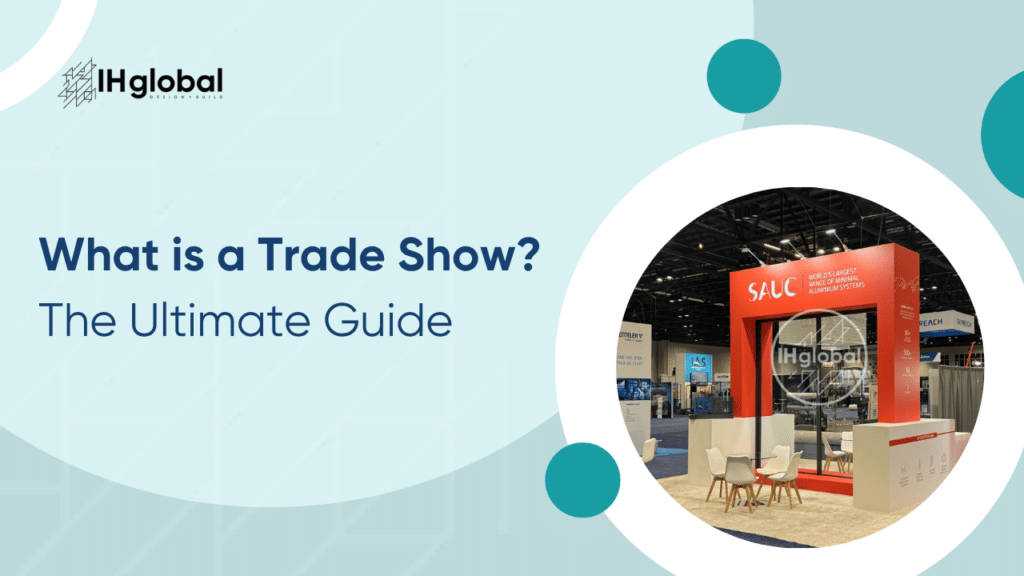
A trade show, also called a trade fair, trade event, or expo, is an organised event where businesses within a specific industry gather to showcase their latest products, services, and innovations. These events typically take place in large convention centres and are open to industry professionals, buyers, distributors, press, and sometimes the general public.
Trade shows differ from consumer exhibitions in one key way: the audience is primarily B2B (business-to-business). Every conversation on the show floor is a potential partnership, sale, or distribution deal. That is why companies invest significantly in their exhibition stall design and fabrication — it is not just a display; it is a business development tool.
Types of Trade Shows
Industry-specific trade shows
These are the most common. Events like Pack Expo for packaging, Aero India for aerospace and defence, and CES for consumer technology attract highly targeted audiences. Exhibitors know that every visitor who walks into their booth has a relevant reason to be there, which is why working with experienced exhibition stand design companies makes a real difference to the final output.
Horizontal trade shows
These events span multiple industries and are ideal for companies offering cross-sector solutions such as logistics, HR technology, or financial services. They attract a broader audience but require sharper messaging to stand out on the floor.
Regional vs. international trade shows
Regional trade events are excellent for market entry and cost-effective networking. International trade shows like Pack Expo 2026 in Chicago offer access to global buyers and press, but demand stronger booth investment and advance logistics planning.
Why Do Companies Participate in Trade Shows?
| Business Goal | How Trade Shows Help |
| Lead generation | Direct access to qualified buyers in a single venue |
| Product launches | Live demos create immediate feedback and buzz |
| Brand awareness | Physical presence signals credibility and scale |
| Competitor research | Observe competitor positioning and messaging firsthand |
| Partnership development | Face-to-face meetings accelerate trust-building |
| Market intelligence | Visitor behaviour reveals real demand signals |
Beyond transactions, many companies use trade shows as a springboard for immersive brand storytelling. Some invest in a permanent customer experience center to extend the same showroom experience throughout the year, not just during event season.
Trade Shows in India: A Growing Market
India’s trade show industry has expanded rapidly over the past decade. Major expos like Aero India in Bangalore, Auto Expo in Delhi, and India Energy Week in Goa now attract global exhibitors and thousands of senior buyers annually.
Key advantages of exhibiting at trade shows in India:
- Cost-efficient fabrication without compromising on build quality
- Competitive pricing that frees up budget for better technology and graphics
- A growing calendar of niche B2B events across manufacturing, defence, pharma, energy, and agriculture
- Strong access to South Asian buyers and decision-makers
Trade Shows in the USA: What International Exhibitors Need to Know
The United States hosts some of the world’s largest and most commercially significant trade events. From the Las Vegas Convention Center to McCormick Place in Chicago and the Georgia World Congress Center in Atlanta, U.S. venues are enormous and operationally complex.
International exhibitors should plan for three key differences:
Union labour rules: Most U.S. shows require union labour for electrical work, rigging, and material handling. Labour rates vary significantly by state and overtime charges after 4:30 PM can double or triple the standard rate.
Booth dimensions in square feet: U.S. shows sell space in square feet, not square metres. A 10ft x 20ft booth (200 sq ft) is roughly equivalent to 18.6 square metres. Understanding this conversion matters when briefing your design team.
Advanced warehousing: Ship materials at least 45 days before the event. Materials sent to an advance warehouse are transported to the show site on move-in day, reducing on-site pressure significantly.
IH Global USA operates across all major U.S. exhibition cities. Whether you need Las Vegas trade show booth builders, a dedicated trade show booth builder in Orlando, or a specialist trade show booth company in San Francisco for Moscone Center events, we handle the full project from design to dismantling.
Working with an experienced trade show exhibit partner who understands U.S. venue-specific regulations, union coordination, and shipping timelines is essential for a smooth experience.
What Makes a Great Trade Show Booth?
Your booth is your brand’s first impression on the show floor. The difference between a forgettable display and a high-converting exhibit comes down to five things:
- Clear messaging above eye level — Visitors scan from a distance. Your headline message should be readable from at least 10 metres away. If it requires them to walk right up, you have already lost most of the foot traffic.
- Open layouts that invite entry — A one side open stall design works well for focused messaging and controlled visitor flow. A 3 side open stall design maximises visibility from multiple aisles and suits brands with more products to display.
- Live product demonstrations — Live demos are the single most effective conversion tool on a trade show floor. Visitors who see or interact with your product are significantly more likely to engage in a follow-up conversation.
- Comfortable meeting spaces — Even a small seating area signals that you want a real conversation, not just a brochure hand-off. It also increases average visitor dwell time.
- Technology that adds something real — Screens, touchpanels, and AR or VR setups help explain what your product cannot show on its own. Read the full guide on interactive trade show booth setups to see what works across different industries and booth sizes.
Best Trade Show Booth Designs for Tech Startups
Startups face a specific challenge: limited budgets competing against large-booth enterprises. The most effective approach is to go deep rather than wide. A compact, well-designed 10ft x 10ft booth with a sharp product demo, strong lighting, and a clear call-to-action often outperforms a cluttered 30ft island stand.
Key principles for startup booths:
- Lead with the problem you solve, not your company name
- Use a live screen demo or interactive touchscreen as the visual centrepiece
- Station one team member outside the booth to engage passersby proactively
- Use modular systems that can be reused and reconfigured across multiple events
- One sharp leave-behind piece beats a stack of brochures people do not carry home
For more creative direction, browse our roundup of the best trade show booth ideas that have worked across different industries and booth sizes.
Best Practices for Trade Show Booth Design
These apply regardless of budget or booth size:
- Stay consistent with your brand. The graphics, lighting, furniture, and the way your team speaks should all feel like the same company. Inconsistency erodes trust quickly.
- Do not try to say everything. Pick three things you want visitors to take away and design everything around those three messages.
- Set up lead capture before the show opens. Badge scanners or digital forms work. Do not rely on collecting business cards and sorting them later.
- Invest in quality construction. Professional exhibition stand contractors build modular systems that can be updated and reconfigured across years of shows. A well-built booth is an asset, not a one-event cost.
- Write your follow-up emails before you travel. The worst time to draft outreach is when you are exhausted after a multi-day show. Have it ready to personalise and send within 48 hours of the event closing.
How to Choose the Right Trade Show for Your Industry
Not every trade event will move the needle for your business. Before committing your budget, evaluate each show against four criteria:
- Audience quality over quantity — Does the attendee list include the buyers, specifiers, or partners you want to reach? A smaller specialised show with the right audience beats a massive general expo every time.
- Competitive density — If every major competitor exhibits there, you need a strong presence. If the show lacks your key rivals, it may not yet be the right venue for your category.
- Geographic fit — Exhibiting in India makes sense if your target buyers are in the South Asian market. International shows like MODEX Expo in Atlanta are better suited for brands targeting global supply chain and logistics buyers.
- Return on investment track record — Ask industry contacts what results other companies have achieved at the event. Past ROI is the strongest predictor of future performance.
How to Generate Leads Effectively at a Trade Show
The goal of most trade show participation is qualified leads. Here is a proven framework:
Pre-show:
- Announce your participation via email, social media, and LinkedIn at least 3 weeks before the event
- Schedule meetings in advance with key prospects
- Pre-booked appointments convert at a much higher rate than cold floor conversations
On the show floor:
- Use badge scanners or lead capture apps rather than business cards
- Train your team to ask qualifying questions within the first 90 seconds of every conversation
- Identify buyer intent early and route conversations accordingly
Follow-up within 48 hours:
- Lead temperature drops sharply after 72 hours
- Reference something specific from the booth conversation in your follow-up email
- Tag and score leads in your CRM immediately so your sales team can prioritise outreach accurately
Companies Offering Custom Trade Show Displays
When looking for custom trade show display builders, evaluate partners on three dimensions: creative capability, in-house fabrication, and logistics experience. The strongest partners handle everything from concept to dismantling, reducing your operational burden and ensuring consistency between the approved design and what actually appears on the show floor.
IH Global has delivered 1,500+ projects across 30 countries, working with global brands at major shows including Pack Expo, CES, RE+, and Aero India. With production facilities in Bangalore, Delhi, and Mumbai, and a U.S. presence in Houston and Las Vegas, IH Global offers end-to-end trade show services for both Indian and international markets.
Conclusion
A trade show is far more than a temporary display. It is one of the most powerful brand experiences your company can create. When planned strategically and executed with precision, trade shows generate qualified leads, build lasting relationships, and elevate your market positioning in ways that digital channels alone cannot replicate.
Whether you are exhibiting at domestic trade events in India or taking on a major U.S. expo, the foundation is always the same: a clear brand story, a purposeful booth design, and a team prepared to convert every conversation into a business outcome.
IH Global has been helping brands bring that story to life for over 22 years. From initial concept to final dismantling, we manage every detail. Learn more about IH Global and what we do.
FAQ
What is the difference between a trade show and a trade fair?
The terms are often used interchangeably. “Trade fair” is more common in Europe and Asia, while “trade show” is the standard term in North America. Both refer to organised events where companies exhibit products and services to a B2B audience.
How much does it cost to exhibit at a trade show?
Costs vary widely by show size, location, and booth complexity. At major U.S. shows, a 10ft x 20ft inline booth with custom design, fabrication, logistics, and on-site support typically ranges from $15,000 to $50,000. Indian trade shows are significantly more cost-efficient. Contact an exhibit partner for a tailored estimate based on your brief.
What are the best trade show booth designs for tech startups?
Compact, modular booths with a central interactive demo, strong brand messaging at height, and a clear meeting area perform best for startups. Avoid clutter. One strong visual story beats ten product panels.
How do I find a trade show booth builder with quick turnaround?
Look for partners with in-house fabrication facilities like. In-house production eliminates third-party vendor delays and gives you direct quality control at every stage, from material cutting to final assembly.
How far in advance should I plan for a trade show?
For major international shows, begin planning 4 to 6 months in advance. For U.S. shows, ship materials at least 45 days before the event and submit any Exhibitor Appointed Contractor (EAC) forms at least 30 days prior.
Can I reuse a custom trade show booth at multiple events?
Yes, and it is strongly recommended. Modular booth systems allow you to reconfigure the same structure for different footprints, swap graphic panels for different campaigns, and reduce costs across a multi-show calendar.