For decades, the factory visit was the holy grail of industrial sales.
A prospect wants to buy your machinery? Take them to the plant. A client wants to check your quality? Walk them through the production floor. A procurement team needs confidence? Show them your operations in person.
It made sense. Seeing is believing. And in industrial B2B, where deals run into crores, buyers wanted proof before they committed.
But factory visits come with a long list of problems. Problems that most industrial companies have quietly accepted but never actually solved.
Until now.
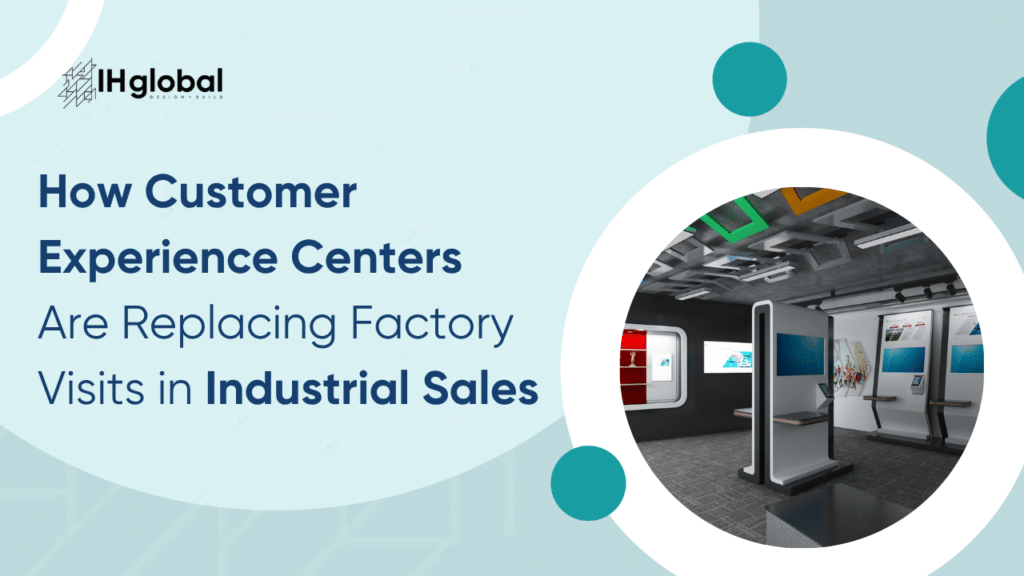
Customer Experience Centres are changing how industrial companies sell. They are not just an alternative to the factory visit. In many ways, they are a better version of it.
Here’s why.
The Factory Visit Was Never Really About the Factory
Think about what a buyer actually wants when they ask for a factory visit.
They want to see that you’re real. That your capabilities match your claims. That your quality standards are what you say they are. That your team knows what they’re doing.
In short, they want confidence.
The factory floor is just the medium through which that confidence has traditionally been built.
But here’s the thing. The factory floor is one of the worst possible environments in which to build that confidence.
The Hidden Problems With Factory Visits
Any industrial company that has hosted a serious buyer at their plant knows the friction involved.
Safety is a constant concern. Most manufacturing facilities require full PPE, hard hats, safety boots, ear protection, high-visibility vests. For a visiting executive or client delegation, this is uncomfortable. It sets a clunky tone before a single word of business is spoken.
Noise makes conversation almost impossible. Production floors are loud. Machines run continuously. Communication breaks down. The very place you’re bringing someone to impress them often makes it impossible to actually talk to them clearly about what you do and why it matters.
There are areas you simply cannot show. Sensitive production processes. Proprietary equipment. Ongoing work for other clients. Classified projects. Every plant has areas that are off-limits to visitors for reasons of confidentiality, compliance, or safety. This means the client never gets the full picture, which can actually increase doubt rather than resolve it.
Scheduling is a logistical nightmare. Production floors run on tight schedules. They’re not designed for visitor experiences. A busy production day is not the ideal backdrop for a high-stakes sales conversation. And organising a visit for a full buying committee — with four to ten people from different cities, is an exercise in coordination that often takes weeks.
The visit is hard to control. On a live production floor, anything can happen. Equipment breaks down. Workers are busy. The environment is unpredictable. You cannot curate the experience. You cannot guarantee that the impression your visitor takes away is the one you intended.
What a Customer Experience Centre Changes
A well-designed Customer Experience Centre addresses every single one of these problems, while delivering everything a factory visit was meant to deliver.
Capability without the chaos. A Product Demo Centre showcases your manufacturing capabilities in a purposefully designed environment. Scale models, interactive displays, material samples, process demonstrations, everything your buyer needs to verify your claims, without the noise and the PPE.
Your full story, not a restricted slice. On a factory tour, visitors see what they’re allowed to see. In an Experience Centre, you choose exactly what to present and how. You can include digital content, videos, case studies, and live demonstrations to cover the parts of your process that cannot be shown in person. Nothing is off-limits. Nothing is left to chance.
A controlled, curated journey. Every zone of the centre has a purpose. Every transition is planned. The visitor moves from understanding your history and credentials, to experiencing your product capabilities, to seeing your quality processes, to having a focused business conversation, all in a single visit. There is no noise, no interruption, no unpredictability.
Comfortable for executives. Your buyer’s CEO is not going to enjoy standing on a factory floor in an ill-fitting hard hat. But they will have a productive, high-quality conversation in a well-designed meeting space that reflects the seriousness of your business. An Experience Centre respects the time and comfort of senior visitors in a way that a factory tour simply cannot.
Scalable for any audience. A factory visit works for one small group at a time. An Experience Centre can host multiple groups, can be configured for different types of visitors, and can run consistently week after week, without disrupting operations.
What You Can Show in a CEC That You Can’t Show in a Factory
This is where Experience Centres truly shine for industrial companies.
Scale models of large equipment. If your product is a 50-tonne machine, you cannot bring it to a meeting room. But you can present a precision scale model alongside interactive displays and detailed technical content that communicates the same thing.
Live process simulations. Technology allows you to simulate complex manufacturing or engineering processes within the Experience Centre, giving buyers a clear, visual understanding of how your solution works, without access to a live production environment.
Before and after product comparisons. You can display product samples, material cross-sections, and quality demonstrations in a way that is impossible to communicate on a noisy production floor. Buyers can see, touch, and compare, at their own pace.
Client project case studies brought to life. Rather than handing over a PDF, your team can walk buyers through real client success stories using visuals, data, and interactive content built into the centre. This is far more compelling than a brochure.
Your global operations and capacity. Interactive displays can show your full plant network, production capacity, delivery timelines, and international presence, giving overseas or distant buyers confidence without needing to fly them across the country.
What This Looks Like in Practice
IH Global has built Customer Experience Centres and Product Demo Centres for industrial companies across India.
For Aequs — a precision manufacturing company in Belagavi, we built a Product Demo Centre that brings their manufacturing capabilities to life for clients in aerospace and defence, without the limitations of a live factory environment.
For FFG — at Bangalore’s Hi-Tech Defence and Aerospace Park, we created an Experience Centre that showcases advanced machinery and engineering solutions in an immersive, controlled space designed for high-level client visits.
For Trevisan India in Coimbatore, we built a dedicated R&D Centre that allows the company to demonstrate their engineering capability to prospects and partners in a purposeful environment.
In each case, the goal was the same: create a space that builds more confidence, more efficiently, than a factory tour while removing all the friction that comes with one.
The Industrial Buyer Is Changing
It’s also worth acknowledging that the buyer showing up at your factory today is not the same buyer who came ten years ago.
A large and growing percentage of industrial procurement decision-makers are younger, more digitally fluent, more design-conscious, and more demanding of structured, professional experiences.
They have grown up expecting the same quality of experience at work that they encounter in every other part of their professional life. They expect clarity. They expect preparation. They expect the seller to have invested in presenting their capabilities properly.
Walking a client through a noisy, dusty production floor and hoping the impression sticks is no longer enough. The bar has been raised.
Factory Visits Still Have a Place
To be clear, we are not saying factory visits are dead.
For certain buyers at certain stages of a relationship, seeing the actual production floor still matters. It builds a specific kind of trust. It answers specific questions about scale, workforce, and operational reality.
But the factory visit should come after the Experience Centre visit, not instead of it.
The Experience Centre does the heavy lifting first. It builds the initial confidence, communicates the full story, and handles the complex multi-stakeholder sales conversation. By the time the buyer sees the factory, they are already largely sold. The factory visit becomes a confirmation, not a first impression.
This is how the best industrial companies in the world are now structuring their sales process.
The Bottom Line
Factory visits were never really about factories. They were about trust.
A Customer Experience Centre builds that trust more effectively, more consistently, and for more types of buyers without the hard hat, the noise, the scheduling headache, or the restricted-access awkwardness.
For industrial companies competing for high-value clients in defence, aerospace, manufacturing, energy, and engineering this is not just a nice upgrade.
It is a competitive shift that is already underway.
The companies that build their Experience Centres now will be the ones setting the standard that everyone else follows in five years.
Want to explore what a Customer Experience Centre or Product Demo Centre could look like for your industrial business?