Most companies show up at trade shows hoping for the best. They build a booth, send a team, collect some business cards, and head home wondering if it was worth the spend. The ones that consistently walk away with qualified pipeline do something different. They plan with precision and execute with purpose.
These ten trade show tips cover every phase of the event cycle, from choosing the right show to following up after the floor closes. Whether you are looking for trade show tips for beginners or reviewing trade show tips with experience, each one directly affects your return. These trade show tips for beginners through to advanced practitioners all connect to the same fundamentals. These are the trade show tips that move the needle.
TL;DR: Quick Summary
These trade show tips are built around one principle: every element of your event participation, from show selection to post-show follow-up, should connect to a specific commercial outcome. Trade show marketing is not a passive activity. It rewards brands that plan deliberately and execute consistently across all three phases of the event.
What you will learn:
- How to choose the right trade events for your business goals
- What makes a trade show booth that converts rather than just displays
- How to use trade show video displays and technology to engage visitors
- The lead capture and follow-up practices that separate high-converting exhibitors
- Key trade show tips for beginners exhibiting at their first events
- How to measure success and improve with every show
Trade Show Tip 1: Define Clear Goals Before You Commit to Any Show
This is the most important of all trade show tips, and also the most frequently skipped. Before you look at a single event calendar, decide what success looks like in specific, measurable terms.
Vague goals like “generate leads” or “build brand awareness” are not goals. They are directions. Set objectives you can measure before the event opens: how many qualified leads you need, how many demonstrations you want to deliver, what pipeline value you are targeting, and what specific business goal this event serves. Your answers determine which trade events to prioritise, what technology to invest in, and how to brief your team. Every other trade show tip in this guide depends on getting this one right. This is your most fundamental trade show tip.
Trade Show Tip 2: Choose the Right Trade Events for Your Audience
One of the most practical trade show tips for any exhibitor: not all trade events are worth attending. A show with 40,000 attendees where 3% are your buyers delivers fewer qualified conversations than a niche event with 3,000 attendees where 60% match your ideal customer profile.
When evaluating trade events, confirm: the attendee profile matches your specific buyer definition, your direct competitors exhibit there consistently, the show has delivered results for similar companies, and the location aligns with your target market.
These trade show tips for show selection save more budget than any other decision. For companies looking at the Indian market, the guide to upcoming trade fairs in Bangalore covers major trade events across manufacturing, tech, energy, and construction, with dates, venues, and audience profiles. For manufacturing sector brands specifically, the India Manufacturing Show in Bangalore is one of the most targeted domestic trade events for reaching industrial buyers and procurement heads.
Trade Show Tip 3: Invest in Your Trade Show Booth Design
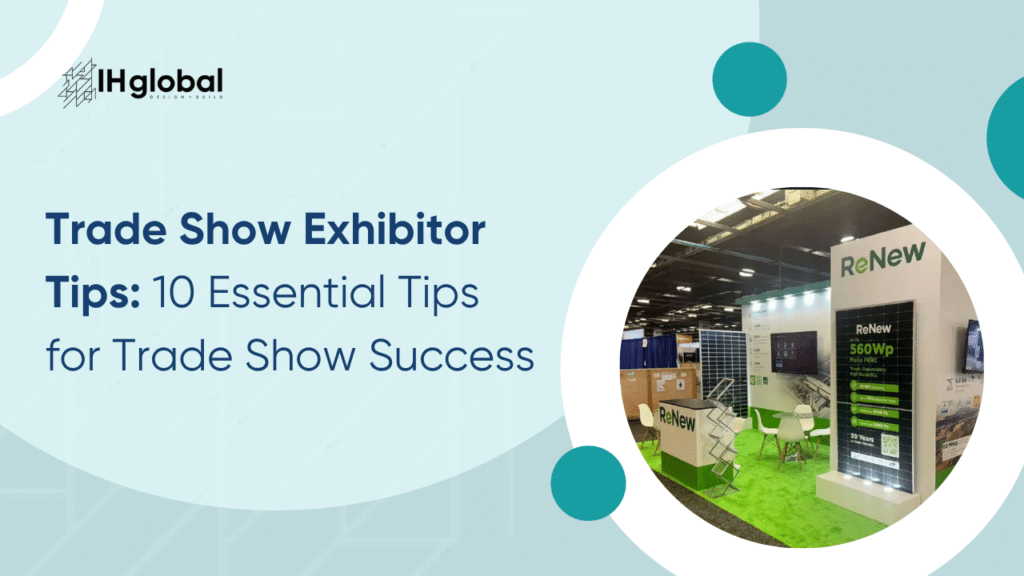
Your trade show booth is doing sales work before your team says a single word. Visitors decide within three to five seconds whether to stop at your trade show booth or walk past. That decision is made almost entirely on visual impression.
A well-designed trade show booth needs to do three things simultaneously:
- Communicates what you do and who it is for, from at least 10 metres away
- Creates an open, welcoming layout that does not feel like a sales trap
- Includes a visual centrepiece, a live demonstration, a bold product display, or an overhead structure that draws attention from across the aisle
Of all the trade show tips about investment, this one delivers the best visual return. Strong exhibition stall design and fabrication is not a luxury. It is the foundation that every other trade show tip builds on. A poorly designed trade show booth undermines the best pre-show marketing, the most qualified attendee list, and the most thoroughly trained staff. These are the trade show tips that make every other decision work. These are the trade show tips that underpin every other. Invest here before anywhere else.
Trade Show Tip 4: Build Your Trade Show Marketing Strategy Early
Most exhibitors start their trade show marketing two weeks before the show. The best ones start six to eight weeks out and treat pre-show activity as a core part of their strategy, not an afterthought.
Your trade show marketing before the event should include:
- An email campaign to existing contacts and target prospects announcing your participation and booth number
- LinkedIn content building toward the event, including a preview of what you will be demonstrating or launching
- Direct personal outreach from sales reps to key accounts, with an invitation to book a meeting at the booth
- A specific, compelling reason to visit: a product launch, an exclusive demo, or an incentive for pre-registered visitors
75% of trade show attendees decide which booths to visit before the event opens. Your trade show marketing determines whether your booth is on that list, and it costs far less than adding floor space.
Trade Show Tip 5: Brief Your Booth Staff Like They Are Running a Campaign
The quality of your team on the floor determines conversion more than any element of your booth design. A brilliant booth with undertrained staff produces weaker results than a modest booth with a sharp, prepared team.
Every person staffing your trade show booth should know the two qualifying questions to ask in the first 90 seconds, how to route high-intent versus casual visitors, and the event-specific pitch for that audience. Run a briefing session the day before the show. Assign specific roles: aisle engagement, live demonstrations, and qualified conversations. These trade show tips for staff preparation directly affect conversion more than any design decision.
Trade Show Tip 6: Use Trade Show Video Displays and Technology Strategically
Trade show video displays are among the most visible and most misused elements in exhibition design. A large LED screen showing a looping product video is not the same as a trade show video display that actively drives engagement. The trade show tips in this section are specifically about using trade show video displays as a conversion tool, not just a background visual.
Apply these trade show tips when briefing your AV partner. Trade show video displays work best when they:
- Show your product solving a real problem, ideally using real client data or live demonstration footage
- Create visible movement that draws attention from across the aisle
- Change dynamically rather than looping static content, which visitors learn to ignore quickly
Beyond trade show video displays, these technology trade show tips consistently produce the best results:
- Interactive touchscreens with product configurators or case study navigators that give visitors a self-guided exploration path
- CRM-integrated badge scanners that capture lead data in real time and sync directly to your sales pipeline
- AR or VR environments to replace trade show video displays for products too large or complex to demonstrate physically
- Real-time lead capture apps that record context alongside contact details, not just name and email
Good trade show video displays, combined with real-time lead capture, create a measurably stronger conversion path. The guide on trade fair lead generation covers lead capture tools and how to integrate them with your follow-up process for maximum conversion.
Trade Show Tip 7: Qualify Every Lead in Real Time
One of the most overlooked trade show tips is this: collecting 400 badge scans and sorting through them a week after the show is one of the most expensive mistakes in trade show marketing. By the time you follow up, most of those leads have moved on or forgotten the conversation.
Real-time lead qualification means asking the right questions during the interaction, not after:
- What are they currently evaluating or looking to change?
- What is their decision timeline?
- Who else is involved in the decision?
Two qualifying questions in the first 90 seconds of every conversation give you the context to prioritise follow-up accurately. Record those answers immediately in your lead capture system alongside the contact details. A lead with context converts significantly better than a lead that is just a name and company.
Segment all leads on the show floor, not the following Monday: immediate need, near-term, and longer-term nurture. These trade show tips for live qualification are the ones most exhibitors skip.
Trade Show Tip 8: Follow Up Within 48 Hours, With Context
Of all the trade show tips in this guide, timely follow-up produces the most immediate commercial impact. Research consistently shows that lead temperature drops sharply after 72 hours. Brands that follow up within 48 hours with a personalised message referencing the specific conversation close significantly more deals than those that send a generic email five days later.
Your follow-up email should:
- Reference something specific from the booth conversation: a product question they asked, a challenge they mentioned, or a comparison they were making
- Deliver exactly what you said you would send, whether a case study, a spec sheet, or a demo recording
- Include a clear, single call to action: a meeting booking link, a product page, or a next step
Among all trade show tips, fast personalised follow-up produces the most immediate commercial impact. Generic follow-up emails are the single biggest waste of trade show investment. If your booth team captured good qualifying notes, the follow-up practically writes itself. If they did not, that is a briefing and process problem to fix before the next show.
Trade Show Tip 9: Measure Trade Show Booth Performance Against the Right Metrics
One of the most repeated trade show tips is “measure your ROI.” Less common is guidance on how to do it accurately.
The biggest measurement mistake is evaluating trade show performance at 30 days. B2B deals sourced at events rarely close in 30 days. Using a 90 to 180-day attribution window gives you a realistic picture of what the show actually produced.
Track qualified leads (against documented criteria, not badge scans), pre-booked meetings completed, CRM opportunities within 30 days, and pipeline value within 90 days. Calculate total cost including staff time and divide by your average deal value to find your break-even point. These trade show tips for measurement pay off most when applied consistently across trade events. Run this analysis after every show.
Trade Show Tip 10: Treat Every Show as a Learning Cycle
The tenth of these trade show tips is the most compounding one. Most brands treat trade show tips as a one-time checklist. The brands that improve fastest revisit their trade show tips after every show: the data from each event should directly improve the next one.
After every show, debrief on: which messages and demos produced the strongest reactions, what booth elements created friction, what your best leads had in common, and what you would change about marketing, briefing, or follow-up. Brands that apply these trade show tips as a repeatable system consistently improve their cost per qualified lead. The brands that get the strongest trade show marketing returns over time are not the ones with the biggest budgets. They are the ones that learn the fastest.
For companies wanting to build a permanent brand experience that works year-round, beyond individual trade shows, a customer experience center brings the same immersive, product-led storytelling from your booth into a dedicated facility that is available to prospects and partners every day of the year.
Trade Show Tips for Beginners
For first-time exhibitors, these are the trade show tips for beginners that deliver the most per hour invested.
Choose the right show first. A modest stand at the right event beats a large booth at the wrong one every time. Keep the booth focused: one clear message, one live demonstration, one seating area for real conversations. Brief your team more than feels necessary and run a practice session the day before. Follow up within 24 hours with a personalised email referencing the conversation. And choose your partner carefully.
Working with experienced exhibition stand contractors who handle design, fabrication, logistics, and installation means your team can focus entirely on the floor. Good trade show companies ask what you want to achieve before designing anything. These trade show tips for beginners apply to domestic and international events equally.
Innovative Interactive Display Ideas for Booths
A few formats consistently drive dwell time across trade events: problem-diagnosis kiosks where visitors answer three questions and receive a personalised recommendation; live side-by-side comparisons using real client data; and VR environments for brands at shows like the India Green Energy Expo where large products cannot attend physically. Browse the IH Global portfolio to see how leading trade show companies have executed these across industries.
Conclusion
Apply these trade show tips across every phase of the event cycle. These ten trade show tips cover: goal setting, show selection, trade show booth design, pre-show trade show marketing, staff preparation, technology, lead qualification, follow-up, measurement, and continuous improvement. The trade show tips that produce the biggest returns are not the expensive ones. They are the disciplined ones. Trade show video displays, trade show companies, booth design, and follow-up process all matter. But the trade show tips that compound most are the ones applied consistently, show after show.
IH Global has been helping brands apply these trade show tips at scale for over 22 years across 1,500+ projects in 30 countries.
Learn more about IH Global‘s trade show services.
FAQ
How do I design an engaging trade show booth layout?
Design for three zones: an attraction zone visible from the aisle, a demonstration zone in the middle, and a seating area at the back for qualified conversations. Keep layouts open without barriers. Position your headline message at height so it is readable from 10 metres. These are among the most actionable trade show tips for booth design because they connect physical space directly to visitor behaviour and conversion.
What are the top trade show booth design services for tech companies?
Tech companies need booth design services that integrate live software demos and trade show video displays into a coherent visitor journey. Look for trade show companies with dedicated technology integration experience. These trade show tips apply regardless of booth size or budget. The best providers design trade show video displays into the booth flow from the brief stage. In-house capability and experience at major tech events like CES are the strongest indicators of the right partner.
How do I measure trade show ROI effectively?
This is one of the most important trade show tips to get right. Set your KPIs before the event, not after. Track all contacts in your CRM and measure pipeline value over a 90 to 180-day window. Calculate your total event cost including booth fees, design and fabrication, logistics, travel, and staff time. Divide total cost by your average deal value to find the minimum deals needed to break even. Run this analysis consistently across trade events to build a benchmark that tells you which shows to scale and which to cut. Measuring only immediate sales significantly undervalues trade show marketing performance for B2B companies.
What are the best trade show tips for beginners that deliver immediate results?
Prioritise show selection, team briefing, and follow-up speed. The right audience, a prepared trade show booth team, and personalised follow-up within 48 hours outperform any booth design upgrade. These trade show tips for beginners hold up at every stage of growth. The best trade show tips for beginners are not complicated. They address three decisions: which show you attend, how your team performs, and what happens after the floor closes.
Guide to selecting the right trade show for your industry?
Start with audience fit. Verify your specific buyer is in the room, not just that the show is large. Check past attendee demographics, which trade show companies and direct competitors exhibit consistently, and what ROI outcomes similar brands achieved. For domestic Indian trade events, our city-specific guides cover audience profiles, dates, and venue details. For international shows, ask exhibit partners for case studies from those specific venues.
Which companies specialise in custom booth design and construction?
Look for trade show companies with in-house fabrication, direct venue experience, and end-to-end project management. The best trade show companies eliminate third-party delays by controlling the full production process. Trade show companies that also advise on strategy, not just build, help you apply trade show tips like modular reuse and integrated technology from the brief stage. When comparing trade show companies, ask for case studies at your specific target venues.
What are innovative interactive display ideas for trade show booths?
Among all trade show tips for engagement, format choice matters most. The interactive display formats that consistently drive the strongest dwell time and lead quality are: live product demonstrations using real visitor data or live scenarios rather than canned demos; problem-diagnosis kiosks where visitors answer three questions and receive a personalised recommendation on the spot; side-by-side before-and-after comparison screens using real client data; and VR environments for products that are too large, complex, or safety-restricted to demonstrate physically. These formats work across industries and budget levels because they give visitors a reason to stop, participate, and have a genuine conversation with your team.