TL;DR
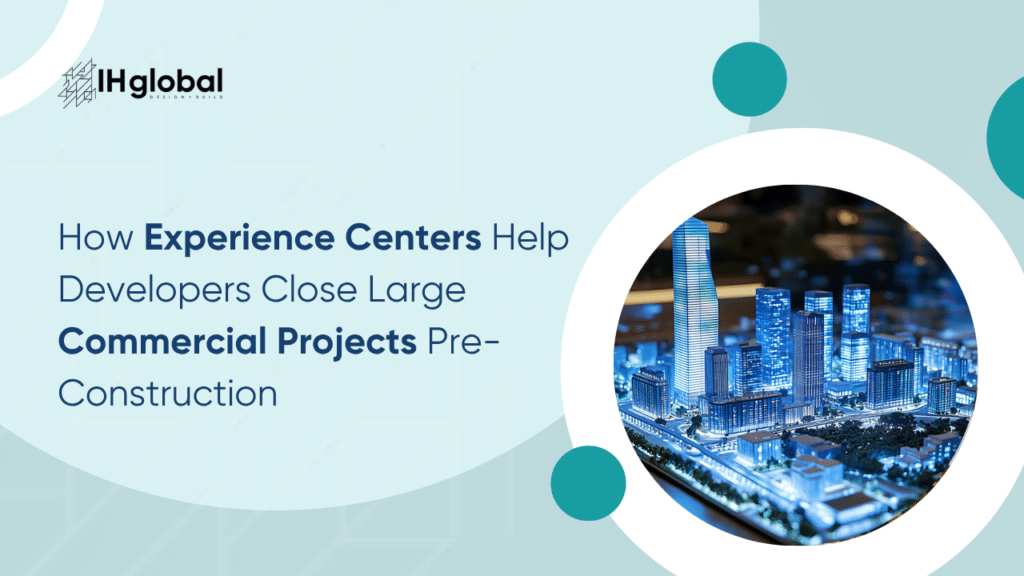
- Commercial real estate experience centers help developers close large projects pre-construction by using VR, AR, and interactive storytelling to help buyers visualise the finished asset before it exists.
- These experience centers improve stakeholder confidence, simplify complex project communication, and accelerate pre-launch leasing and investment through immersive, real-time visualisation and engagement.
The challenge of selling a large-scale commercial development lies in what might be called the ‘gap of imagination.’ When a project exists only as a plot of land, a skeletal frame, or a set of architectural renders, potential tenants and investors frequently struggle to grasp the scale, quality, and operational experience of the finished asset.
A commercial real estate experience center bridges this gap — providing a high-tech, physically immersive environment where a developer’s vision becomes a tangible reality. According to Deloitte’s commercial real estate outlook, over 60% of commercial real estate executives now prioritise digital tenant experience and high-tech property tours as primary drivers of pre-launch leasing momentum.
By using an experience center strategically, developers can secure tenant commitments and attract investment capital well before the first ribbon is cut — transforming the pre-construction period from a commercial vulnerability into a competitive advantage.
Accelerating Pre-Construction Property Sales Through Sensory Immersion
The primary commercial goal of a commercial real estate experience center is to facilitate pre-construction commitment by eliminating the guesswork that makes investors and tenants hesitant. Rather than reviewing flat 2D renders on a laptop screen, prospects enter a curated physical environment that simulates the actual completed building at a sensory level.
- Tactile Finishes: Allowing tenants to physically touch the actual marble, stone, or glass specified for the lobby — confirming material quality beyond what any photograph can convey.
- Acoustic Simulations: Demonstrating the soundproofing performance of office partition systems in realistic configurations, which is a critical concern for corporate tenants evaluating operational comfort.
- Virtual Perspective: Using drone-captured panoramas and VR headsets to show the exact view from a 40th-floor office suite, a rooftop terrace, or a podium retail frontage — before the structure exists.
- Scale and Volume Experience: Full-scale mock-up rooms that allow buyers to experience ceiling heights, column spacing, and floor-to-ceiling glazing ratios firsthand, rather than interpreting them from a floor plan.
Explore the future of customer experience centers to understand how forward-thinking developers are positioning these spaces as permanent marketing and stakeholder engagement assets.
The Strategic Advantage of Customer Experience Centers for Developers
Generic marketing suites and on-site trailers are becoming obsolete. Today, specialised customer experience centers for commercial real estate developers create a distinct emotional and intellectual connection between the project brand and the investor — a connection that a brochure or a website cannot replicate.
The JLL Global Real Estate Outlook highlights that major corporate tenants are increasingly making leasing decisions based on technology readiness, sustainability credentials, and community integration — factors that require immersive demonstration rather than simple specification. Experience centers that address all three simultaneously give developers a decisive edge in competitive leasing environments.
These spaces enable deep-dive exploration of floor plan configurations, infrastructure specifications, sustainability certifications (LEED, WELL, BREEAM), and community impact plans — topics that require focused, in-person conversation with access to physical and digital reference material.
Mastering Commercial Project Visualisation in a Physical Space
Investors in large-scale commercial assets are inherently risk-averse. A commercial real estate experience center uses commercial project visualisation to demonstrate exactly how the building will perform — financially, operationally, and physically — before a single structural element is in place.
Interactive display zones can model energy efficiency performance against benchmarks, show traffic flow simulations for retail or hospitality zones, and project the building’s sustainability performance over its operational lifetime. This transparency directly addresses the primary objection in commercial real estate pre-sales: the perceived risk of committing capital to an asset that does not yet exist.
The conversation shifts from “What if the building doesn’t perform as promised?” to “Based on what we’ve just seen, when are we signing?” — which represents a fundamental change in commercial momentum.
Elevating Commercial Real Estate Marketing Through Brand Identity
A real estate experience center is a living embodiment of the project’s brand identity. It communicates not just the architectural specification, but the lifestyle, prestige, and community value of the address — the qualities that drive leasing decisions in premium commercial real estate markets.
The most effective developer experience centers use every sensory dimension to communicate brand quality:
- Ambient Branding: Signature scent profiles and curated acoustic environments that create an immediate visceral impression of the building’s character before a word is spoken.
- Curated Art and Material Storytelling: Art installations and material displays that reflect the cultural positioning of the development — communicating the developer’s vision to both institutional investors and prospective corporate tenants.
- Transaction-Ready Environments: Executive lounge areas and private meeting rooms within the center that allow high-level negotiations and term-sheet discussions to take place in an environment that reinforces the project’s premium positioning.
Read 7 key trends in customer experience centers to see how real estate developers are incorporating experiential branding into their pre-launch strategies.
Interactive Property Experience Centers: Making the Intangible Real
To convince a major corporation to commit to a headquarter relocation, a developer must demonstrate not just the building, but the context in which it sits — the vibrancy of the surrounding district, the connectivity of the transport infrastructure, and the quality of the amenity ecosystem.
Interactive property experience centers use real-time digital displays to present nearby infrastructure data, transit network maps, demographic analysis, and competitive commercial real estate benchmarking — all within a navigable, touchscreen-enabled environment that allows visitors to explore the project’s context at their own pace.
This contextual intelligence layer is what differentiates a premium experience center from a standard marketing suite — and according to CBRE’s global market outlook, it is precisely the kind of transparent, data-driven engagement that corporate real estate directors require before committing to long-term lease agreements.
Using Experience Centers for Community Engagement and Planning Approval
Beyond investor and tenant sales, experience centers play a strategically important role in the planning and community consultation phase. They serve as a neutral, accessible venue where local authority representatives, community groups, and neighbouring stakeholders can engage with detailed project plans, visualise construction management protocols, and raise specific concerns in a constructive, facilitated environment.
By providing this level of accessible transparency within a commercial real estate experience center, developers can proactively address community concerns around construction impact, traffic management, environmental performance, and local economic contribution — often converting potential opposition into active support before planning hearings begin.
This dual function — as both a commercial sales environment and a community engagement hub — makes the investment in an experience center strategically significant far beyond the pre-launch sales period.
The Importance of a Professional Commercial Property Experience Center
In commercial real estate, the quality of the pre-sales environment sends an unambiguous signal about the quality of the finished asset. A substandard marketing suite communicates that the developer has not fully committed to the project’s promise. Conversely, a world-class commercial property experience center immediately establishes credibility and raises the investor’s confidence threshold.
The most effective centers are those designed by partners who understand both the spatial communication requirements of architecture and the commercial imperatives of the property sales process. Explore 15 ways IH Global can help create a world-class experience center to understand the design and technology elements that differentiate the most successful developer experience centers.
Conclusion
The ability to sell a large commercial project before it is built represents one of the most significant competitive advantages in modern real estate development. A commercial real estate experience center is the most powerful tool for achieving this — combining sensory immersion, data-driven transparency, and brand storytelling to convert cautious stakeholders into committed partners.
At IH Global, we specialise in designing experience centers that help commercial developers close deals faster, at better values, with greater stakeholder confidence. View our portfolio to see our work with property developers and infrastructure brands, or contact our team to discuss your project.
Frequently Asked Questions
What is the purpose of a commercial real estate experience center?
A commercial real estate experience center allows developers to present a pre-construction project at a sensory, immersive level — enabling potential tenants and investors to experience the scale, quality, and ambience of a finished building before it exists. This directly addresses the trust and confidence gap that typically delays pre-construction leasing and investment commitment.
Why are experience centers important in commercial real estate development?
Pre-construction sales depend on a buyer’s ability to visualise an asset that does not yet physically exist. Traditional marketing tools — renders, floor plans, scale models — provide some visual reference but cannot deliver the sensory confidence that large-scale commercial commitment requires. Experience centers provide that confidence through tactile materials, VR perspectives, acoustic simulations, and live infrastructure performance modelling.
What technologies are typically used in commercial real estate experience centers?
The most effective commercial property experience centers combine physical material displays with VR headset environments, drone-captured aerial panoramas, interactive floor plan and specification configurators, real-time energy and sustainability performance modelling tools, and touchscreen-enabled local amenity and infrastructure displays. The specific technology mix is designed to address the decision criteria most relevant to the project’s target tenant and investor profiles.
Can a commercial real estate experience center increase pre-launch sales?
Yes, consistently. When potential tenants and investors can physically experience the quality of materials, virtually occupy the finished space, and review data-validated performance projections in a single structured visit, their confidence in the investment outcome increases significantly — and directly translates into faster commitment decisions and higher pre-launch transaction values.
How do developers use experience centers to attract institutional investors?
Institutional real estate investors require a higher level of due diligence evidence than retail buyers. Developer experience centers serve this audience by providing structured deep-dive sessions with access to technical performance data, sustainability certification modelling, infrastructure quality verification, and competitive positioning analysis — all within an environment that demonstrates the developer’s commitment to delivering on their promises.
Can experience centers also support planning and community approval?
Absolutely — and this is one of the most underutilised strategic functions of commercial real estate experience centers. By opening the facility to local community stakeholders and planning authority representatives during the consent phase, developers can proactively address concerns, demonstrate environmental mitigation measures, and build community support for the project. This can significantly reduce planning timeline risk and opposition, making the experience center investment valuable across multiple phases of the development cycle.